


A Response to the Claim that Jesus Was a “Nazi” Based on Matthew 15:22-28. By Dr Chapman Chen

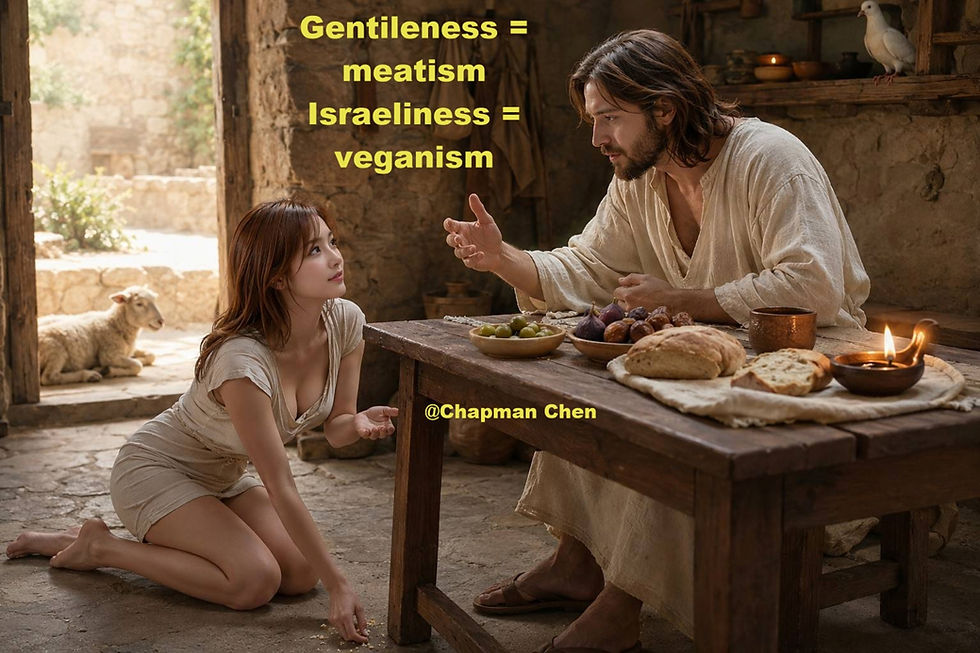
This article is a continuation of my 2026 article, “Why and How the Canaanite Woman Justa’s Daughter was Healed by Jesus” (n.1). The Minister of Wellness (2026) (n.2) alleges that Jesus was a Nazi on the ground that because in Mattew 15:22-28 (n.3) , the woman is African, Jesus ignored her because of race, and Jesus called her a dog because of race, therefore Jesus was racist, therefore Jesus was “KKK/Nazi”. This charge may be challenged on the following levels.
1. Historical Level
On the historical level, Nazism was a twentieth-century political ideology characterised by racial supremacy, biological determinism, nationalism, militarism, and genocide. Jesus the Nazarene lived nearly 2000 years before the rise of National Socialism. To label a first-century Jewish teacher a "Nazi" is an extreme anachronism and the ultimate insult to Jewish identity and history.
2. Textual Level
On the textual level, even within Matthew's account, Jesus ultimately grants the woman's request and heals her daughter. The story concludes not with exclusion but with acceptance. Far from condemning the woman, Jesus praises her: "Woman, you have great faith! Your request is granted" (Matt. 15:28). The climax of the narrative is therefore mercy rather than rejection.
3. The Gentile–Israelite Distinction Reinterpreted
Thirdly, the Pseudo-Clementine version of the story (The Clementine Homilies — Pseudo-Clementine Literature, Hom. 2, Ch. 19, trans. Thomas Smith 1886) (n.4) offers an alternative interpretation preserved within early Jewish Christianity. Here the distinction between Israel and the Gentiles is explicitly linked to ethical and dietary practices rather than ethnicity. Justa is described as a Gentile "on account of" her use of "various meats and practices." Once she abandons these customs and adopts the vegan lifestyle of the Kingdom, her daughter receives healing. The barrier is therefore ethical rather than racial.
4. A Universal Ethic
More importantly, the Clementine narrative points towards a universal ethic. Justa does not change her race, nationality, language, or ancestry. She changes her conduct. The Kingdom is presented as open to all who embrace its principles. This interpretation is fundamentally incompatible with racism, which judges persons according to immutable characteristics such as ethnicity or ancestry.
5. Jesus’ Inclusive Ministry
The Minister of Wellness's accusation also ignores the broader trajectory of Jesus' ministry. Throughout the Gospel traditions, Jesus repeatedly associates with Samaritans, tax collectors, sinners, women, lepers, and other marginalised groups. He heals the servant of a Roman centurion, converses with a Samaritan woman, and makes a Samaritan the hero of one of His most famous parables. Whatever one thinks of Christianity, the historical record does not support the claim that Jesus advocated ethnic supremacy.
From the perspective of Vegan Theology, the Clementine account points in precisely the opposite direction. The decisive distinction is not race but compassion; not ancestry but conduct; not bloodline but the willingness to renounce violence and participate in the merciful order of God's Kingdom. The story therefore serves as evidence for an early Christian ethic of moral transformation rather than racial exclusion.
6. Conclusion
The accusation that Jesus was a "Nazi" is thus not a serious historical conclusion but an inflammatory slogan. It relies upon imposing modern ideological categories upon an ancient text while ignoring both the ending of the Gospel narrative and the ethical reinterpretation preserved in the Clementine tradition. The story of Justa is better understood as a call to spiritual and ethical transformation, culminating in healing, inclusion, and compassion for all God's creatures.
Notes
3. Matthew 15:22-28 New International Version
22 A Canaanite woman from that vicinity came to him, crying out, “Lord, Son of David, have mercy on me! My daughter is demon-possessed and suffering terribly.”
23 Jesus did not answer a word. So his disciples came to him and urged him, “Send her away, for she keeps crying out after us.”
24 He answered, “I was sent only to the lost sheep of Israel.”
25 The woman came and knelt before him. “Lord, help me!” she said.
26 He replied, “It is not right to take the children’s bread and toss it to the dogs.”
27 “Yes it is, Lord,” she said. “Even the dogs eat the crumbs that fall from their master’s table.”
28 Then Jesus said to her, “Woman, you have great faith! Your request is granted.” And her daughter was healed at that moment.
4. Justa, a Proselyte: "There is amongst us one Justa, a Syro-Phoenician, by race a Canaanite, whose daughter was oppressed with a grievous disease. And she came to our Lord, crying out, and entreating that He would heal her daughter. But He, being asked also by us, said, 'It is not lawful to heal the Gentiles, who are like to dogs on account of their using various meats and practices, while the table in the kingdom has been given to the sons of Israel.' But she, hearing this, and begging to partake like a dog of the crumbs that fall from this table, having changed what she was, by living like the sons of the kingdom, she obtained healing for her daughter, as she asked. For she being a Gentile, and remaining in the same course of life, He would not have healed had she remained a Gentile, on account of its not being lawful to heal her as a Gentile." (The Clementine Homilies — Pseudo-Clementine Literature, Hom. 2, Ch. 19, trans. by Thomas Smith 1886; cf. Matthew 15:22-28)


Comments