


Challenges to Veganism in the NT: Resolved (Draft). Dr. Chapman Chen
- Chapman Chen

- May 16, 2025
- 56 min read
Updated: Feb 7

Introduction: Seemingly anti-vegan verses in the NT are really either misinterpretations or interpolations introduced by “the lying pen of the scribes” (Jer. 8:8). For example, per Luke 24:42-43; John 21:9-13, Jesus distributed and ate fish. Yet, the Greek word for fish (ἰχθύας), as in Mark 6:41, Matthew 14:19, and Luke 9:16, is an acronym for " Jesus Christ, Son of God, Savior" (Akers 2000), a secret code commonly used by the early Christians to avoid persecution; and "fish (opsarion)", as in John 6:9, may also be a mistranslation of the Greek word for "fishweed (opson)" (Hicks 2019; Giron 2013), a popular vean relish among Palestinian peasants both 2000 years ago and now. Jesus' declaration of all foods clean, a phrase in parenthesis (Mark 7:19), must be a later addition to facilitate the gentiles converting to Christianity. Jesus' point is: God's command is more signifiant than men's tradition, and what really defiles us is evil thoughts, evil words, evil attitudes, and evil actions, rather than food taken without washing hands (Mark 7:20-23; Matt. 15:20). Jesus ent 2000 pigs to death (Mark 5:11-13)? Well, "legion (λεγιών/leg-eh-ohn)," the name of the demons, insinuates the Roman military units, whom the colonized Jews secretly loathed and deemed demonic. Further, a factory farm of 2,000 pigs is unlikely to have existed in first-century Palestine. God commanded Peter to kill and eat animals (Acts 10:13)? The real message of the vision, per Peter's own explication, was to show that God had cleansed all gentiles and removed the divide between gentiles and Jews (Acts 10:27). Jesus commanded us to eat His flesh and drink His blood in communion in order to have our sins forgiven (John 6:53-56)? This cannibalistic sounding cult comes straight from Paul the anti-vegan apostate (;1 Cor. 10:16-17, 11:23-26; cf. Tabor 2012:14-15). God & Christ simply do not require blood & flesh to forgive our sins. King David & Bathsheba (2 Sam. 12:13), the adulterous woman (John 8:1–11), & the parable of the prodigal son (Luke 15:11–32) are cases in point. John the Baptist ate locusts (Matt. 3:4 )? Note that Akridas, the Greek word for locusts in Mark 1:6 is probably a corruption of akrios, the tip of a plant, which could well be the date palm (mkali), for the Greek akridas is rendered as mkali or danakiskudi (date palm) in Old Georgian translations (cf. Barnaveli 2018). Paul did encourage people to "eat anything sold in the meat market without raising questions of conscience" (1 Corinthians 10:25), because Paul/Saul, as a Herodian (Romans 16:11), is a secret agent sent by the Roman Empire to corrupt Jesus' vegan church from the inside out (cf. Eisenman 2012; Voskuilen 2005).
Full Text: https://www.vegantheology.net/post/challenges-to-veganism-in-the-nt-resolved-draft-dr-chapman-chen
1. All Fishy Stories about Jesus: Debunked

Executive Summary: Instances of Jesus the Vegan Christ eating fish or helping His disciples to catch fish in the gospels are all products of either misinterpretation or later interpolation (cf. Chen 2023, 2022a, 2022b, 2020).
I. Jesus multiplied "five loaves and two fish" to feed the multitudes (Matthew 14:13-21, Mark 6:31-44, Luke 9:12-17, John 6:1-14)? However, Jesus therein broke and handed out loaves but not fish (Matthew 14).
Moreover, the Greek word for fish (ichthys ἰχθύας), as in Mark 6:41, Matthew 14:19, and Luke 9:16, is an acronym for " Jesus Christ, Son of God, Savior" (Akers 2000), a secret code commonly used by the early Christians to avoid persecution; and "fish (opsarion)", as in John 6:9, may also be a mistranslation of the Greek word for "fishweed (opson)" (Hicks 2019; Giron 2013), a popular vegan relish among Palestinian peasants both 2000 years ago and now.
II. Jesus eating fish to prove to the eleven disciples in Jerusalem on the very night of his Resurrection that he's no ghost (Luke 24: 39-43), and His helping Peter and others to catch fish (John 21:1–14) at the Sea of Galilee, when He manifested Himself to the disciples for the third time after resurrection, are clearly forgeries, for both the dates and the venues contradict Mark and Matthew (cf. Vujicic 2016). Jesus had long told his disciples that he would go to Galilee, not Jerusalem, upon resurrection (Mark 16: 7, 14:28). And the 11 disciples met the post-Resurrection Jesus for the first as well as the last time on a mountain in Galilee (Matthew 28:16), where no fish catching or fish eating occurred. The interpolation theory is corroborated by the fact that Luke 24:42–43 is missing in Codex Bezae Cantabrigiensis, a significant 5th-century manuscript of the New Testament (note 1).
III. Jesus miraculously aided Peter and his folk to catch a huge net of fish (Luke 5:1-11)? But Jesus then asked them to FORSAKE their NETS, follow Him and CATCH MEN INSTEAD OF FISH. Matthew 4:18-20 and Mark 1:16-18 also record this story albeit without the first part.
IV. Jesus directed Peter to go hook a fish and dig a coin from her/his mouth in order to pay a temple tax (Matthew 17:24-27)? This could not be real for, firstly, it was never executed; secondly, it's improbable that Jesus would have performed a complex miracle in order to pay his own tax; thirdly, how could Jesus, who died for animal liberation (Akers 2000), have had the heart to order his disciple to do such a cruel thing to an innocent fish?
So, this instruction, if ever existent, was a sarcastic joke cracked by Jesus to brush off the temple tax collector who wanted to trap Jesus. A refusal on His part to pay the tribute would be represented as disloyalty to the temple; while the payment of it would be taken as justifying their denial of Him as a prophet, for prophets were customarily exempted from the temple tax (cf. White 1898/2017:376-377).
Full Text Link: https://www.vegantheology.net/post/all-those-fishy-stories-about-jesus-revised-by-dr-chapman-chen ;
YouTube link: https://www.youtube.com/watch?v=YFN7GeHlVqI
Contrary to mainstream churches' belief, Jesus Christ was vegan. Instances of Jesus eating fish or helping His disciples to catch fish in the gospels are products of either misinterpretation or later interpolation.
1. Jesus Desires Compassion, not Sacrifice
In Matthew 9:13 (NASB), Jesus admonished the Pharisees, “I desire compassion rather than sacrifice”. In Saying 87, the Gospel of Thomas, as translated and edited by Steven Davies (2002), Jesus said, "Wretched is a body depending on a body". Now, how can a body be dependent on another body? Only if the body eats the other body. Hence, Davies (2002) comes to the conclusion that Thomas is not stating that all bodies are "wretched", just bodies which are dependent on other dead bodies, in other words, meat, for food. When Epiphanius questions a Jewish Christian as to why he was a vegan, the Jewish Christian responds simply: "Christ revealed it to me" (Panarion 30.18.9).

Jesus’s natural brother, James the Just, is reported to have been vegan. "Who and whatever James was, so was Jesus." (Eisenman 1997). Jesus cared about sparrows (Matthew 10:29), fowls (Matt. 6:26), lamb (John 13:6), sheep (Matt. 12:11), doves (Matt. 10:16), hens (Matt. 23:37), donkey (Matt. 21:7), mule(s) (Linzey and Dorothy 1998: 38-39 ; Linzey 2010: 60-61), asses and oxen (Luke 14:5), etc.
Jesus even died for animal liberation. In freeing the sacrificial animals from the Second Temple and in calling it “a den of murderers” (Mark 11:16, Luke 20:46, Matt. 21:12-13), Jesus debunked its violent, fraudulent nature, and disrupted the lucrative income stream of the chief priests and scribes, who immediately afterwards plotted to have Him killed (Mark 11:18), eventually leading to His crucifixion (Akers 2000, 113-134).
2. Jesus did not Distribute Fish
In the miracle of "five loaves and two fish," Jesus broke loaves but not fish (Matthew 14). The Greek word for fish (ἰχθύας) was a code word for " Jesus Christ, Son of God, Savior" (Akers 2000); and "fish" may also be a mistranslation of the Greek word for "fishweed" (Hicks 2019; Giron 2013).
2.1. Jesus Broke Loaves but NOT Fish (Matthew 14)
In the miracle of "Five loaves and two fish," which is narrated in Matthew 14:13-21, Mark 6:31-44, Luke 9:12-17, and John 6:1-14, Jesus neither condoned the eating of fish nor gave it to the masses (Matthew 14). As pointed out by John Vujicic (2009), if you carefully read the text of Matthew 14, you will see that Jesus only broke the LOAVES and gave ONLY THE LOAVES to the people. Twelve baskets were filled with the broken pieces of BREAD. Subsequently, when Jesus referred back to the feeding of five thousand and of four thousand in the Gospel of Matthew 16:9-10 and the Gospel of Mark 8:19-20, He merely made reference to the LOAVES of BREAD AND THE BASKETS which held the broken pieces of bread, and never mentioned in any way the fishes (cf. Phelps 2002, 113-114).
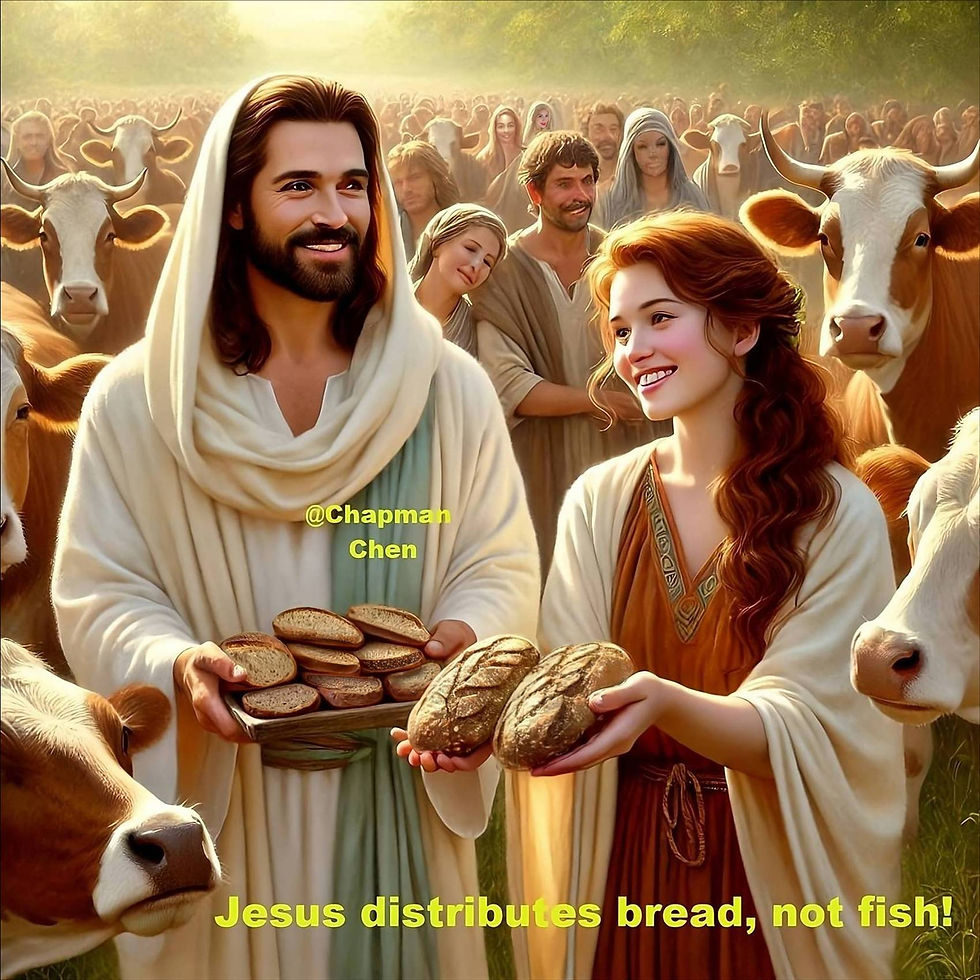
Likewise, Irenaes, in his book written in the 2nd century, twice states that Jesus fed the crowd with bread and nothing else (Against Heresies 2.22.3, 2.24.4; see Akers 2020:126). Arnobius narrates the miracle of the feeding of the 5000 in a similar manner, sans referring to fish (Against the Heathen 1, 46). Eusebius, too, talks about this event sans bringing up fish (Proof of the Gospel 3,4).
In John’s version even though reference is circuitously made to Jesus’s breaking of the fishes, the twelve baskets contained only the broken pieces of FIVE LOAVES. Obviously Jesus used only five loaves to feed the crowd and the reference to the fishes is a subsequent interpolation.
2.2. Fish vs Fishweed
As put by Raw Matt (2019), "Even IF the manuscript is correct, the translation is erroneous." The "fish" in the miracle concerned is probably a mistranslation of a kind of dried seaweed. As found by the author's own research, in the Greek version of John 6:9, the word for "fish" is ὀψάριον (opsarion), which according to Thayer's Greek Lexicon (STRONGS NT 3795), is a "diminutive from ὄψον [opson] (cf. Curtius, § 630) i.e. whatever is eaten with bread, especially food boiled or roasted"; and according to Strong's Exhaustive Concordance, is "a relish to other food (as if cooked sauce)…(presumably salted and dried as a condiment)". So opsarion is not necessarily real fish, but may be just a relish (cf. Phelps 2002, 113).
In this vein, after going through hundreds of ancient Greek writings, Ryan Hicks (2019:148) noted opsarion employed in many ways, including directly denoting plant life. For instance, 800 years before Jesus, Homer employed opson, the origin of opsarion, in his epic The Illiad, book 11, section 630, putting down:
"She first drew before the twain a table, fair, with feet of cyanus, and well-polished, and set thereon a basket of bronze, and therewith an onion, a relish [ὄψον, opson] for their drink, and pale honey, and ground meal of sacred barley..."
Hicks (2019:148) argues that "'fish' can refer to any aquatic life, including the fishweed, seaweed, and other aquatic plants that commonly made up the opsarion/relishes.... In Homer's reference it was an onion that made up the bulk of the relish."
Similarly, Giron (2013) points out that "dried fishweed would be more likely in a basket with bread, and fishweed remains a popular food among Palestinian peasants like the people to whom Jesus was speaking."
Moreover, according to Giron (2013), this helps explain Matthew 4:18-20, where Jesus gets his first disciples by telling some fishermen to give up their profession and follow him. Jesus even says to them "I will make you a fisher of men". Could this be Jesus was having them give up their barbaric line of work to do something more righteous? It may sound absurd, but it starts to make a little more sense when you take it in the same context as the story of feeding five thousand, where the disciples never even considered trying to catch some fish, despite being beside the sea. Why didn't they go fishing? Did Jesus teach it was wrong to eat fish?
2.3. Ichthys = Jesus Christ, Son of God, Savior
A noteworthy observation concerning the fish symbol: The Greek word for fish (ἰχθύας/Ichthys) was an acronym or code word for " Ἰησοῦς Χρῑστός Θεοῦ Υἱός Σωτήρ [Jesus Christ, Son of God, Savior]", popular among early Christians for the sake of avoiding persecution (cf. Akers 1989; Regenstein 1991; Altar n.d.). And in the Greek version of Mark 6:41, Matthew 14:19, and Luke 9:16, the word for fish as in "the five loaves and two fish" is none other than ἰχθύας!
3. Jesus Eating Fish after Resurrection is Fake News!

Luke's story of Jesus eating fish to prove to the eleven disciples at evening on the day of his Resurrection that he's no ghost is clearly a forgery, for both the date and the venue contradict Mark and Matthew.
Luke 24: 39-43 and John 21:1-14 are the only places in the New Testament that mention Jesus eating meat. According to Luke, Jesus ate fish (ἰχθύος/Ichthys) in front of 11 disciples in Jerusalem on the first night of his Resurrection: "Behold my hands and my feet, that it is I myself: handle me, and see; for a spirit hath not flesh and bones... And while they yet believed not for joy, and wondered, he said unto them, Have ye here any meat? And they gave him a piece of a broiled fish, and of an honeycomb. And he took it, and did eat before them" (Luke 24: 39-43 KJV).
However, according to the Gospel of Mark 16: 7 and 14:28, Jesus had long told his disciples that he would go to Galilee upon resurrection. According to Mark 16: 9 -19, Jesus revealed himself thrice after resurrection, the first time to Mary Magdalene; the second time to two disciples on the road; the third time to all the 11 disciples, presumably in Galilee. According to Matthew 28:16, the eleven disciples went up a mountain in Galilee as specified by Jesus, where Jesus met them the first time as well as the last time after He rose from the dead. So the Gospel of Luke's claim that Jesus ate fish in front of the disciples in Jerusalem on the very night of his Resurrection is wrong in terms of both date and venue. Apparently, it is fabricated and not to be believed (cf. Vujicic 2016). The same applies to a resurrected Jesus helping His disciples to catch and cook fish at the sea of Tiberius in John 21:1-14. Notably, John 21 is widely regarded by scholars as an appendix or later addition (see Raymond Brown, Rudolf Bultmann, etc.).
3.1. Fishy Story Interpolated to Combat "Heresies"
According to Akers (2000:128), this fishy story was interpolated by Luke (Paul the anti-vegan, self-proclaimed apostle's underling) in order to combat veganism as wells as "the idea of the 'docetic Christ' -- the idea, held by certain Gnostics such as Marcion, that Jesus had no real body," being just a phantom or a ghost. The consumption of fish is a particular demonstration by Yeshua that He is no phantom:- "Touch me and see; a ghost does not have flesh and bones, as you see I have” (Luke 24:39 NIV).
3.2. Luke 24:42–43 Missing in Codex Bezae
The interpolation theory is corroborated by the fact that Luke 24:42–43 is missing in some of the oldest manuscripts, including Codex Bezae (D). Codex Bezae Cantabrigiensis is a significant 5th-century manuscript of the New Testament, notable for its distinctive Greek and Latin texts. The manuscript is housed at the Cambridge University Library and has been digitized for online access (https://archive.org/details/bezaecodexcanta00cambgoog/page/322/mode/2up).
4. Jesus did not Supply Fish to His Disciples at the Sea of Tiberias
Similarly, the report of John 21:1-14 cannot be right and Peter accompanied by several of his fellow disciples could not have been catching fish at the sea of Tiberias (John 21:1) after Jesus’ rise from death. Jesus did not supply fish to his disciples there because that showing up, in accordance with Matthew's and Mark's account, never occurred. (Interestingly, the word in the Greek version for fish as in John 21:13 is ὀψάριον [opsarion], which as mentioned earlier, could refer to a dried Mediterranean seaweed.)
Further, John, just like Luke, alleges that Jesus’ foremost showing up occurred in the evening of the first day, while the door was barred where the disciples were grouped together. John asserts that this was the earliest showing up and that Thomas was absent. It's not until seven days after that Jesus purportedly showed up to his disciples again while Thomas was there, too. This fails to concur even with Luke who says that all eleven disciples were there when Jesus manifested himself to them in the Holy City after rising from the dead (cf. Vujicic 2016).
Again, as aformentioned, fish (Ichthys) was a well known mystical symbol amidst these early Christians for "Jesus Christ, Son of God, Savior" (Akers 1989; Regenstein 1991). Given how the early Christians employed the term, there is therefore good historical evidence for the argument that all of the "fish stories" that managed to get into the gospels were intended to be taken symbolically rather than literally.
5. Jesus Calls Peter to Catch Men, NOT Fish!
Meat-eating "Christians" often claim that Jesus was not vegan on the ground that He helped disciples like Simon Peter to catch fish both before crucifixion and after resurrection.
Admittedly, in Luke 5:1-11, Jesus miraculously aided Simon Peter, etc. to catch a huge net of fish, but He then asked them to FORSAKE their NETS, follow Him and CATCH MEN INSTEAD OF FISH. Matthew 4:18-20 and Mark 1:16-18 also record this story but without the first part, which was probably added by Luke himself to dramatize how Jesus recruited His first disciples.
Also, in John 21:1-15, a resurrected Jesus enabled 7 of His disciples to catch a large number of fish by the sea of Galilee, and had breakfast with them. But this appearance is widely believed to be a later interpolation, which is neither mentioned in Matthew nor in Mark.
In fact, not only was Jesus vegan but He died at least partly for the cause of animal liberation (Chen 2022; Chen 2020; Akers 2000).
6.1. Pre-Crucifixion "Fishing" Biblical Texts
Now let us examine in detail the pre-crucifixion "fishing" Biblical texts in question:
18 As Jesus was walking beside the Sea of Galilee, he saw two brothers, Simon called Peter and his brother Andrew. They were casting a net into the lake, for they were fishermen. 19 “Come, follow me,” Jesus said, “and I will send you out to fish for people.” 20 At once they left their nets and followed him. (Matthew 4:18-20 NIV)
16 As Jesus walked beside the Sea of Galilee, he saw Simon and his brother Andrew casting a net into the lake, for they were fishermen. 17 “Come, follow me,” Jesus said, “and I will send you out to fish for people.” 18 At once they left their nets and followed him. (Mark 1:16-18 NIV)
1 One day as Jesus was standing by the Lake of Gennesaret... He got into one of the boats, the one belonging to Simon... and taught the people from the boat.4 When he had finished speaking, he said to Simon, “Put out into deep water, and let down the nets for a catch.”...6 When they had done so, they caught such a large number of fish that their nets began to break...8 When Simon Peter saw this, he fell at Jesus’ knees and said, “Go away from me, Lord; I am a sinful man!” 9 ... 10 and so were James and John, the sons of Zebedee, Simon’s partners...Then Jesus said to Simon, “...from now on you will fish for people.” 11 So they pulled their boats up on shore, left everything and followed him. (Luke 5:1-11 NIV)
6.2. Catch (Transform) Humans instead of Fish
From the three passages quoted above, we can see that Mark and Matthew just mention Jesus commanding Peter and his brother Andrew to leave behind their fish nets, follow Him and fish for people. Luke is the only Gospel to describe Jesus helping Peter and his folk to catch a huge amount of fish before commanding them to leave everything and follow Him.
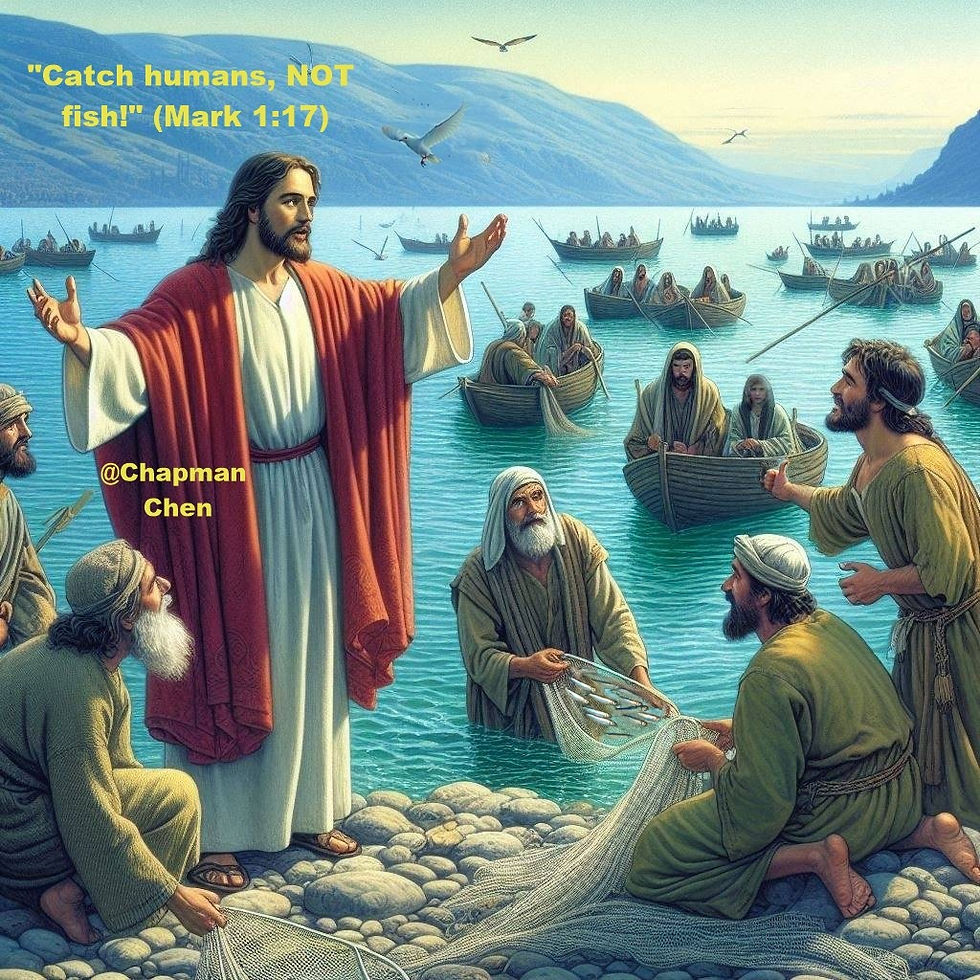
Apparently, the key message of this pre-crucifixion "fishing" story is, in particular, Jesus asking Simon Peter, etc. to catch (TRANSFORM) PEOPLE INSTEAD OF FISH; in general, Jesus telling people to QUIT their EARTHLY OCCUPATION if called upon by God to pursue a path otherwise.
The gist of the story is by no means Jesus performing a miracle to help Simon Peter and Andrew catching a huge net of fish. Indeed, even if this story is real, "The thing missed by most people when reading this story is that 'they forsook all, and follow him.' There is nothing about them taking the fish to market. They forsook the barbaric life they were living in order to follow the Lord Jesus", according to Ryan Hicks (2018).
Luke inserted the tale of Jesus miraculously helping His first disciples to catch a huge number of fish probably for the sake of making the whole thing more dramatic, juicy and intriguing.
7. Fish-hooking Never Meant by the VEGAN Christ!
According to Matthew 17:24-27, Jesus commands Peter to go hook a fish and dig a coin from her/his mouth in order to pay a temple tax which the tax collectors has asked Peter whether Jesus has paid or not. Some animal-eating Christians have seized upon this story as proof that Jesus was not a vegan. But this weird "miracle" could not be real because of the following reasons. Firstly, it’s never fulfilled. Secondly, it's an implausible command. What? Merely for the sake of getting a small coin for paying the temple tax, Jesus actually goes into the trouble of performing a complex miracle, which involves Peter going to the sea, throwing in a hook, catching a fish, and prying open her/his mouth to look for the coin? Isn't it a bit over the top?). Thirdly, Jesus never performed a miracle for personal gain or relief for his own needs. Fourthly, it's unique with no close canonical parallel; it is only recorded in Matthew. Fifthly, it was Jesus Himself who had asked Peter to catch men instead of fish (Matt. 4:18-22). How come He now commands Peter to catch a fish? Sixthly, "I desire compassion, not sacrifice!" famously declared Jesus (Matt. 9:13, 12:7). As aforementioned, He even died for the cause of animal liberation (Akers 2000, 113-134). How could He, a dedicated animal rights activist, have had the heart to command someone to cruelly hook up an innocent fish, and pry open her/his mouth in order to obtain a coin for paying His own tax? So much the more, as His disciple, Peter must know that his teacher was a vegan. How come in this story, he was never astonished by his teacher's bizarre command?

This "miracle" is probably a sarcasm made by Jesus to cleverly deal with the tax collectors bent on forcing him to reveal whether He is an establishment man or a tax rebel.
The tribute concerned was not a civil tax, but a religious contribution, which every Jew was required to pay annually for the support of the temple. A refusal on Jesus’ part to pay the tribute would be represented as disloyalty to the temple; while, on the other hand, the payment of it would be taken as justifying their rejection of Him as a prophet, for the chief priests, Levites and prophets were exempted from this payment. https://www.ellenwhite.info/books/ellen-g-white-book-desire-of-ages-da-48.htm
Just like the Pharisees who, subsequently, in order to trap Jesus, ask Him, "Is it right to pay the imperial tax to Caesar or not?" (Matthew 22:17 NIV), the tax collectors are here asking Jesus a tricky, political question. Instead of asking whether Jesus’ current tax bill is paid up, they are asking “whether he is an establishment man or a tax rebel, a part of the mainstream Judaism or on the fringe” (Long 1997). To borrow the words of Vinson (2013), "Jesus is in a Catch-22" and his reply could lead to a rift in his ministry.
Thus, in order to avoid offending the tax collectors, Jesus cleverly responds to them with the strange command to Peter in the same way that Jesus later tactfully answered the Pharisees, “give to Caesar what belongs to Caesar, and give to God what belongs to God” (Matthew 22:21 NLT), which, in Liu's (2013) interpretation, means "everything belongs to God". This kind of tactfulness reminds us of "as sheep in the midst of wolves: be ye therefore wise as serpents" (Matt. 10:16 KJV).
In my interpretation, Jesus' awkward command to Peter is a sarcasm, which effectively says, "Ok, I will pay the temple tax if only my disciple Peter could find a shekel in the first fish caught by him today." But of course, Peter, familiar with his master's character, never actually goes catch a fish and opens her/his mouth in an attempt to find the coin for paying the temple tax.
Alternatively, Albright and Mann (1995) contend that the narrative may be the remnant of a Jewish legend, "much on the lines of folk tales found in the rabbinic tradition of the lost-and-found-again variety." There are actually similar Jewish stores in Babylonian Talmud Shabbat 119a; Genesis Rabbah 11:4, and other cultures provide numerous examples (France 2007: 671).
7. Conclusion
In conclusion, "God is love" (1 John 4:8 KJV); Jesus is compassion (Mark 6:34); Jesus was/is a Vegan Christ. He did not eat fish or any other kind of meat while living as a human being on earth. He even died for the sake of liberating innocent creatures of God. All those biblical stories about Jesus consuming fish, multiplying/distributing fish, and aiding/directing His disciples to catch fish are fishy business, products of "the lying pen of the scribes" (Jeremiah 8:8). Let's all follow Jesus' example of compassion and go vegan.
3. Jesus Never Declares All Foods Clean. Go Vegan! By Dr. Chapman Chen

Summary: Jesus' declaring all foods clean, a phrase in parenthesis (Mark 7: 19), and thus permitting the eating of all animals, must be a later addition to accommodate the gentiles converting to Christianity, as it is absent in KJV and the Greek manuscripts. Moreover, grammarwise, the participial phrase, “purging [καθαρίζων] all [πάντα] the [τὰ] food [βρώματα]?” (Mark 7:19 KJV), is in grammatical discordance with the rest of the sentence (cf. Beer 2014). And the sign of interrogation (question mark) “is rarely found before the ninth century” (Metzger 1964:27).
Equally importantly, the context is some Pharisees criticizing Jesus' disciples for failing to wash their hands ritualistically before eating bread. The conversation is centered around whether one should hold the tradition of the elders and always wash one's hands before eating. And Jesus' conclusion is: God's command is more significant than men's tradition, and what really defiles us is evil thoughts, evil words, evil attitudes, and evil actions, rather than food taken without washing hands (Mark 7:20-23; Matt. 15:20). Here, Jesus is not saying that we can eat any kind of unclean food or animal flesh (cf. August 2022, 298; Beer 2014).
Full Text: https://www.vegantheology.net/post/jesus-never-declares-all-foods-clean-go-vegan-by-dr-chapman-chen
1. Bible Verses Concerned:
15 There is nothing from without a man, that entering into him can defile him: but the things which come out of him, those are they that defile the man…. 18 And he saith unto them, Are ye so without understanding also? Do ye not perceive, that whatsoever thing from without entereth into the man, it cannot defile him; 19 Because it entereth not into his heart, but into the belly, and goeth out into the draught, purging all meats? (Mark 7:15-19 KJV)
For it doesn’t go into their heart but into their stomach, and then out of the body.” (In saying this, Jesus declared all foods clean.) (Mark 7: 19 NIV)
2. "Jesus declared all foods clean" as a Later Addition
The declaration in parenthesis “purging [καθαρίζων] all [πάντα] the [τὰ] food [βρώματα]?” can only found in certain versions like NIV, which came into existence after the King James Version, one of the earliest English translations of the Holy Bible. The earliest available Greek Manuscripts as shown in Biblehub do not contain it. So it must be a remark added by later scribes or translators (cf. Bbvulf 2013)
2.1. Grammatical Discordance
As pointed out by Beer 2014, “purging” (καθαρίζων) is a participium (which functions as the verb of the clause), whereas “he said” (λέγει) is an indicative verb. “And He [Jesus] said to them…[Jesus is] cleansing all the foods” "would not make sense grammatically."
2.2. Punctuation Problem
According to Metzger (1964:26-27), the early papyri as well as the uncial manuscripts have “only an occasional mark of punctuation”, and the sign of interrogation (question mark) “is rarely found before the ninth century” (Metzger 1964:27).
As pointed out by Beer 2014, the least we can construe from the texts with punctuation is that later scribes (copyists)" attempted to signify that the phrase “purging καθαρίζων all πάντα the τὰ food βρώματα” (Mark &:19) should be set apart from the remaining of the sentence. This could mean: "the phrase is not part of Jesus’ question to his followers, but rather an editorial note by Mark".
3. Background of the Verses Concerned:
The Pharisees and certain scribes from Jerusalem spot some of Jesus' disciples eating bread with "unwashen hands" and query Jesus why should his disciples not follow the tradition of the elders and wash their hands before eating (Mark 7:1-5 KJV).
Jesus' response may be divided into three stages.
3.1 Stage one:-
Jesus bluntly calls the Pharisees and scribes "hypocrites" and asserts that in holding "the tradition of men", like the washing of pots and cups, [and of hands before eating], they are in fact going against the commandment of God (Mark 7: 6-13 KJV). So Jesus definitely is not canceling the kosher code and the vegan diet prescribed by God upon creating humans. Instead, he is upholding them as opposed to the tradition of men adhered to by the Pharisees.
3.2 Stage two:-
Jesus tells the crowd that nothing that enters a man from without can defile him while it is the things that come out of him that defile him (Mark 7: 14-15). This is somewhat covert and unspecified. Concerning the first limb, it is not specified whether Jesus is talking about food or something else, like air or sound. But judging from the background as laid out at the beginning of this chapter, it must refer to food eaten with unwashen hands, that the Pharisees claim to be defiled. As for the second limb, it is not specified whether Jesus is talking about exhaled breath, excretion, thought, or action or attitude.
3.3 Stage three:-
Jesus' speech at Stage 3 is more specific and profound than that at Stage 2.
Jesus leaves the crowd and enters the house, where his disciples ask him about the meaning of the "parable" (Mark 7: 17 KJV). The word "parable" suggests that Mark 7:15 is to be understood figuratively or metaphorically.
Jesus then questions his disciples rhetorically: Are you so dumb as to fail to see that whatsoever enters the man from without cannot defile him because it enters his belly instead of his heart and then goes out into the sewer:
"And he saith unto them, Are ye so without understanding also? Do ye not perceive, that whatsoever thing from without entereth into the man, it cannot defile him; Because it entereth not into his heart, but into the belly, and goeth out into the draught, purging all meats?" (Mark 7:18-19 KJV)
Apparently, food ingested, which will become ejected feces, is what Jesus is talking about here. Again, judging from the background as laid out at the beginning of Mark 7, it is not any food, but food eaten with unwashen hands, which the Pharisees frown at. And, as aforementioned, "purging all meats" does not fit in the picture. Grammatically and structurally, it is situated too far away from the subject it is supposed to describe -- "he [Jesus]". Semantically, are we actually supposed to believe that Jesus cleanses all the foods in the universe, including animal flesh like pork, while uttering Mark 7:19? Contextually, Jesus, as aforementioned, is upholding God's commandment concerning food rather than going against it.
Lastly, Jesus clarifies and specifies that it is “evil thoughts,” evil actions—such as murder, deceit, and lasciviousness—evil words like blasphemy, and evil attitudes such as pride and foolishness, that proceed from the heart of people and defile them (Mark 7:20–23 KJV). To avoid any misunderstanding, Jesus further confirms in Matthew: “These are what defile a person, but eating with unwashed hands does not defile them” (Matt. 15:20 NIV).
4. Conclusion
To conclude, Jesus did not declare all foods clean, for the declaration in parenthesis can only be found in English translations after the KJV. Nor did Jesus repeal the Torah or the Kosher code. The phrase "purging all meats" must be a later remark or comment added by either Mark or some scribe after him. The line "whatsoever thing from without entereth into the man, it cannot defile him" is merely a kind of figurative speech or parable. By no means did Jesus mean that we can eat any kind of unclean food or animal flesh; He is not repealing the Kosher code.
In Mark 7, Jesus is essentially saying that God's command is more important than men's tradition, that even if we eat without washing our hands first, the food taken in from without will not defile us; that on the other hand, evil thoughts and actions, etc. that come out of our heart will defile us. This interpretation is powerfully confirmed by Matt. 15:20.
This conclusion is corroborated by the fact that Jesus was a vegan, as argued in Linzey (1994), Akers (2000), Saba (2006), York and Alexis-Baker (2012), Chen (2020), Beer (2014) and Erwin (2010), and that He taught veganism (Panarion 30.18.9).
4. Jesus Did Not Drive 2000 Pigs to Death

Summary: The Gadarene swine story (Mark 5:1-20; note a) cannot be taken literally for there’s no factory farming 2000 years ago, and how could Jesus the Vegan Christ, who eventually died for liberating animals from the Temple (Akers 2020), have had the heart to drive 2000 innocent creatures of God to death?! It is best interpreted from a postcolonial cum Freudian perspective. From a postcolonial anti-imperial perspective (Leander 2013), the narrative, which tells of Jesus exorcising demons from a man into a herd of swine that then drown themselves, can be seen as a metaphor for Jewish resistance against Roman colonialism. "Legion (λεγιών/leg-eh-ohn)," the name of the demons, insinuates the Roman military units, whom the colonized Jews secretly loathed and deemed demonic.
From a Freudian perspective (Weatherhead 1951), the word “legion” reveals the possessed person/psychiatric patient’s repressed traumatic memory of being brutalized by the Roman soldiers or witnessing brutality by them. The possessed man's shrieks and the hurriedly returning herdsmen might have panicked the pigs, causing them to dash and charge off the cliff into the sea.
1.1. One Human Life is More Important than 2000 Innocent Animals? ?
Pastor R.C. Sproul (2019) writes in his commentary on Mark that Jesus' compassion “drove Him to destroy the pigs for the sake of one human life. That is how valuable human life is.” In his 2017 book Vintage Jesus, Mark Driscoll, pastor of the megachurch Mars Hill in Seattle, states disdainfully that as Jesus drove the demons into the swine, he drove “the animal rights blogosphere into a panic” and generated “a bacon famine only rivaled by the great Irish potato famine” (Driscoll and Breshears 2017:43). Pastors and theologians like them stand in a long tradition of employing this biblical story to rationalize cruelty against innocent creatures of God (cf. Spalde and Strindlund 2012:102).
St. Augustine of Hippo (354-430 AD) referenced this episode, together with another story in which Jesus lays a curse on a fig tree, to contend that Jesus cares about neither animals nor plants. In the 13th century, Thomas Aquinas, in answering the objection that it is not appropriate for Jesus to work miracles that hurt humans or other creatures, asserted that “Christ came specially to teach and to work miracles for the good of man, and principally to the salvation of his soul. Consequently, he allowed the demons that he chased out to do men some harm, either in his bodyor in his property, for the salvation of man’s soul—namely, for man’s instruction” (Aquinas, Summa Theologiae, III-II 44, ad. 4). In essence, the killing of the pigs serves as a lesson for humanity.
In other words, these vegan-haters are so anthropocentric as to think that it is alright for God to sacrifice 2000 innocent animals to save one human life. But there is good reason to believe that the Gerasenes pigs story is a metaphoric parable.
2. No Factory Farming 2000 Years Ago!

First and foremost, there was no factory farming 2000 years ago. A group of two thousand pigs is comparable to a modern factory farm in size, yet in those times, pigs roamed freely and weren't managed in the same way. Maintaining such a large number of pigs would have been a massive undertaking, requiring up to four times the number of caretakers needed for other livestock like sheep. It's doubtful that anyone during the era of Jesus could manage so many pigs, considering the average pig herd then ranged from 100 to 150. This casts doubt on the likelihood that the biblical account of "several thousand pigs" was meant to be taken literally by its readers (cf. Spalde and Strindlund 2012:106-7; Fussell 1967:35).
3. Jesus is a Compassionate Vegan Christ
Even more importantly, how could Jesus, as a Vegan Christ (cf. Chen 2023) who died for the cause of animal liberation (cf. Chen 2024b), have had the heart to harm 2000 innocent creatures of God?
3.1. Jesus has a Vegan Family
It is widely recognized that James, who led the Jerusalem church following Jesus' ascension and was Jesus' brother, strictly adhered to a vegan diet from childhood, as noted by Eusebius (Ecclesiastical History 2.23.5–6). This raises the question: If James was brought up vegan, why wouldn't Jesus have been raised the same way? It logically follows that both Jesus and James were brought up by their parents as vegans, suggesting that veganism was an integral aspect of the original teachings of the gospels. (Akers 2015).
3.2. Jesus Warns against Flesh-Eating
Jesus warns against flesh-eating:- “Now beware in yourselves that your hearts do not become heavy with the eating of flesh…that day will come up upon you suddenly; for as a snare it will come upon all of them that sit on the surface of the earth” (Luke 21:34, Evangelion Da-Mepharreshe — Old Syriac-Aramaic Manuscript of the New Testament Gospels).
Also, in Saying 87, the Gospel of Thomas, as translated and edited by Stevan Davies (2002), Jesus says, "Wretched is a body depending on a body". Now, how can a body be dependent on another body? Only if the body eats the other body. Hence, Davies (2002) comes to the conclusion that Thomas is not stating that all bodies are "wretched", just bodies which are dependent on other dead bodies, in other words, meat, for food.
At least equally importantly, Jesus admonishes the Pharisees, quoting Hosea 6:6, "Go and learn what this means: I desire compassion rather than sacrifice" (Matthew 9:13 NASB). According to Akers (2017), "that would explain why Jesus went into the temple and attacked what he found there", as will be explained below. Similarly, in the Gospel of the Ebionites, Jesus condemns animal sacrifice in the Temple of Jerusalem:- “I have come to abolish the sacrifices, and if you cease not from sacrificing, my wrath will not cease from you” (Panarion 30.16.5). Jesus also rejected the Passover meal :“I have no desire to eat the flesh of this Paschal Lamb with you” (The Gospel of the Ebionites 22.4). When Epiphanius questions a Jewish Christian as to why he was a vegan, the Jewish Christian responds simply: "Christ revealed it to me" (Panarion 30. 18.9).
3.3. Jesus as a Martyr for Animal Liberation
Akers (2020/2000) argues that prior to the Last Supper, Jesus, in emptying the Temple of animals about to be slaughtered for sacrifice, and in calling the Temple-turned-butcher-shop "a den of thieves", quoting Jeremiah 7:11, debunked the business fraud of animal sacrifice, and disrupted the lucrative revenue stream of the chief priests and scribes, who immediately afterwards conspired to destroy Him (Mark 11:15-18), eventually leading to His arrest, trial, and crucifixion. In this sense, Jesus was a pioneer and martyr for animal liberation (cf. Chen 2024b). (I would add that "Cleansing the temple" was an act of animal liberation not unlike Direct Action Everywhere's open rescue of animals from factory farm.)
As for all those fishy stories about Jesus, please refer to Chen (2024a); and as for Jesus allegedly eating the Passover lamb, please refer to Chen (2023).
So the Gadarene swine story can only be taken metaphorically. We may interpret it from both a postcolonial and a Freudian perspective. Both approaches complement each other in this case.
4. A Postcolonial Approach
According to New Testament scholar Hans Leander’s (2013) postcolonial interpretation, the Gadarene swine story, with all its military allusions (Leander 2013:104), e.g., “legion,” “dispatch,” “herd,” “permission,” and “rush,” covertly conveys a coded anti-imperial message (cf. Spalde and Strindlund 2012: 104-5).
4.1. Military Allusions in the Story
4.1.1. “Legion” as a Roman Regiment

When Jesus asked the demon its name, it answered, “Legion”. Now, “Legion" means "a division of 3,000–6,000 men, including a complement of cavalry, in the ancient Roman army" (Encyclopedia .com, OUP). The Greek word rendered as “legion” is λεγιών (pronounced as leg-eh-ohn). It is in actuality of Latin origin and refers to a Roman regiment.

During Jesus' times, the Israelites were colonized and exploited by the Romans. As a result, most Jews did not like the Romans. It's only natural that when the demon calls itself Legion, it’s insinuated that the Roman soldiers were swine possessed by demons.
4.1.2. “Send” as Dispatch
Leander’s (2013) also points out that the word "sent" used twice before the sending of the demons into the swine remind people of a commander sending forth a troop.
The Greek for "send" in "[the demon] begged Jesus again and again not to send them out of the area" (Mark 5:10 NIV) is apostellō (ἀποστέλλω), which means to be set apart or sent with a purpose (cf. Strong 1890; Free Bible Commentary).
The Greek for “send” in "Send us among the pigs" (Mark 5:12) is pempō (πέμπω) which according to Strong's (1890) Dictionary of the Bible really denotes “dispatch.” Leander (2013) argues that it connotes militarily dispatching a troop.
4.1.3. “Permission” as Command
“He gave them permission” (ἐπέτρεψεν αὐτοῖς / epetrepsen autois) can also signify that a military command has been issued (Mark 5:13 NIV).
4.1.4. “Rushing into Battle
The Greek for “rushed” ὥρμησεν (hōrmēsen) implies a troop rushing into battle (Mark 5:13 NIV).
4.1.5. Colonization vs Revolution
The demons plead with Jesus not to "send them out of the country." The swine, deemed impure creatures, might represent the "unclean conquerors" who had taken over the lands of the Jews. Therefore, the self-inflicted demolition of the demon-possessed pigs symbolizes the cessation of this colonization, marked by the expulsion of the Roman troops "out of the country" (Lattea 1996:59). Additionally, this narrative mirrors the events of the exodus, as the demon-filled pigs "rush" into the sea and meet their end, reminiscent of the fate that befell Pharaoh's forces at the Red Sea (cf. Spalde and Strinlund 2012:104).
Expanding our view to the historical backdrop, the Tenth Roman Legion, which was garrisoned in Decapolis—the setting of this account—during the period when Mark composed his Gospel, used a boar on their standard, and the figure of two thousand aligns with the typical size of a Roman legion dispatched to combat Jewish rebels (Leander: 2013:257-58).

In a territory under occupation, "Mark’s portrayal of 'Legion' as subordinate to Jesus clearly carries the potential for subversion," notes Leander. Perhaps, as Leander posits, the tale was documented and disseminated as a means for the subjugated populace to covertly defy the invaders without endangering themselves; the narrative thus conveys the message that "the Romans are not as powerful as they think" (Spalde and Strindlund 2012:104).
In essence, Leander (2013) demonstrates that the "legion" demon allegorizes the Roman Empire's colonization of Israel, causing pain and sufferings to the Jews. In 7 AD, a valiant revolution against Roman colonization broke out, and many others were yet to come (cf. Christopher 2015). Similarly, against China's brutal recolonization of Hong Kong, three revolutions have taken place in this cosmopolitan city, namely, The Umbrella Revolution (2014), The Fishball Revolution (2016), and The Time Revolution (2019). And many Hongkongers would call the atrocious Gestapo-like police "dogs".
5. A Psychoanalytic Approach

According to the English theologian Leslie Weatherhead’s (1951) psychoanalytical interpretation, in the account from St. Mark, a man is heard whispering "Legion," and it's reasonable to think he might have been traumatized by Roman soldiers, known as a legion. The biblical massacre of the innocents gives us an idea of their brutality. It's conceivable that this man had been a witness to such horrors.

Imagine a young boy, witnessing the slaughter of children, fleeing in horror from the bright streets, screaming "Mummy, Mummy, legion!" as he sees soldiers with blood-stained swords. Such a traumatic event, particularly for someone predisposed to emotional instability, could easily lead to a mental breakdown.

Cast out by his community, he finds himself isolated in a desolate graveyard across the border, surrounded by pigs, his mind haunted by terrifying memories that erupt into violent outbursts and screams (Weatherhead 1951:56).
The swine's demise is not hard to grasp, given pigs' tendency to panic. Should the utterance of "Legion" have triggered a release of suppressed memories of trauma from Roman soldiers or Herod's enforcers, it's certain that the pent-up emotions would erupt in loud screams and outbursts. It's plausible that the swineherds, intrigued by the rare sight of a group (Jesus and His disciples) at that late hour, approached out of curiosity and boredom. Neglected during this distraction, the pigs might have been spooked by the man's shrieks. As the swineherds left Jesus' side in a bid to calm the pigs, the animals, in their fright, could have charged off the cliff into the sea. For the man, who believed demons needed a physical form, whether human or animal, this was a fitting outcome (Weatherhead 1951:57).

6. Conclusion
To put it in a nutshell, Jesus is a Vegan Christ. His compassion covers both humans and animals. He would not have had the heart to drive 2000 innocent creatures of God to death. There’s no factory farming 2000 years ago. The Gadarene story had better be treated as a psychological, anti-imperial parable, in which “Legion” symbolizes Roman military occupation of Palestine as well as the Jewish people’s repressed traumatic memory of brutalization by the Roman colonizers.
Note:
a. Mark 5 NIV, Jesus Restores a Demon-Possessed Man:
1 They went across the lake to the region of the Gerasenes. 2 When Jesus got out of the boat, a man with an impure spirit came from the tombs to meet him. 3 This man lived in the tombs, and no one could bind him anymore, not even with a chain. 4 For he had often been chained hand and foot, but he tore the chains apart and broke the irons on his feet. No one was strong enough to subdue him. 5 Night and day among the tombs and in the hills he would cry out and cut himself with stones.
6 When he saw Jesus from a distance, he ran and fell on his knees in front of him. 7 He shouted at the top of his voice, “What do you want with me, Jesus, Son of the Most High God? In God’s name don’t torture me!” 8 For Jesus had said to him, “Come out of this man, you impure spirit!”
9 Then Jesus asked him, “What is your name?”
“My name is Legion,” he replied, “for we are many.” 10 And he begged Jesus again and again not to send them out of the area.
11 A large herd of pigs was feeding on the nearby hillside. 12 The demons begged Jesus, “Send us among the pigs; allow us to go into them.” 13 He gave them permission, and the impure spirits came out and went into the pigs. The herd, about two thousand in number, rushed down the steep bank into the lake and were drowned.
14 Those tending the pigs ran off and reported this in the town and countryside, and the people went out to see what had happened. 15 When they came to Jesus, they saw the man who had been possessed by the legion of demons, sitting there, dressed and in his right mind; and they were afraid. 16 Those who had seen it told the people what had happened to the demon-possessed man—and told about the pigs as well. 17 Then the people began to plead with Jesus to leave their region.
18 As Jesus was getting into the boat, the man who had been demon-possessed begged to go with him. 19 Jesus did not let him, but said, “Go home to your own people and tell them how much the Lord has done for you, and how he has had mercy on you.” 20 So the man went away and began to tell in the Decapolis how much Jesus had done for him. And all the people were amazed.
5. Did Jesus Eat the Passover Lamb?

Contrary to the belief of many theologians — including Thomas Aquinas, Pope Benedict XVI, Craig Keener, Scott Hahn, and N. T. Wright — Jesus did not consume the Passover lamb. The Gospel of John explicitly narrates that Jesus hosted the Last Supper on the Preparation of the Passover (John 13:1). (In the Jewish calendar, a new day begins at sunset.) During the Last Supper, bread instead of animal flesh was blessed by Jesus (Luke 2:14-20; Mark 14:22-24; Matt. 26:26-29). Throughout the entire NT, nowhere is it ever mentioned that Jesus ate lamb.
According to the Gospel of John, besides the Last Supper, Jesus’ subsequent arrest in Gethsemane, trial before Caiaphas, transfer to the Roman governor, crucifixion, death, and burial also occurred on the same day —Preparation Day of the Passover, which was Friday (14 Nisan) — what we now commemorate as Good Friday (John 18:28; 19:14, 31, 42). The chief priests had to rush through all these things within one day because all Jews were supposed to stop working and eat the sacrificial lamb at home on the Passover night (Exodus 12:6–10) (cf. Vujicic 2013).
Importantly, the “Preparation Day” (Nisan 14) was the day before the High Sabbath (Nisan 15). And in that particular year, the High Sabbath fell on a Saturday, which is why John 19:31 says: “for that Sabbath was a high day” — meaning it was both the weekly Sabbath, and the annual festival Sabbath (1st day of Unleavened Bread) (Leviticus 23:6–7; John 19:31).
The other three Gospels claim that the Last Supper was the Passover meal (e.g., Matthew 26:17–20; Mark 14:12–17; Luke 22:7–16), but like John, they also concede that Jesus was crucified on the Preparation Day (Matt. 27:62; Mark 15:42; Luke 23:54). They are thus self-contradictory and unreliable as far as Jesus’ taking of the Passover meal is concerned (cf. Vujicic 2013).
Above all, as a martyr for animal liberation who declared, “I desire compassion, rather than sacrifice!” (Matt. 9: 13, 12:7; cf. Eusebius, Proof of the Gospel, Book III, Ch. 5 [note 1]; cf. The Gospel of the Ebionites apud Epiphanius, Panarion, Book I, 30.16.5 [note 2]), Jesus would not have had the heart to eat the innocent sacrificial lamb. For in emptying the Temple of the animals about to be slaughtered (John 2:14–16; Matt. 21:12–13), and in calling the Temple “a den of murderers” (Matt. 21:13; cf. Jer. 7:11), He disrupted the lucrative income stream of the chief priests and scribes, who immediately afterwards plotted to destroy Him (Mark 11:18; Luke 19:47; Keith 2020, 113-134).
Moreover, Jesus’ baptizer, John the Baptist (Luke 1:80; Matt. 3:4; Slavonic Josephus, Jewish War [note 3], and Jesus’ twelve disciples (Eusebius, Demonstratio Evangelica [Proof of the Gospel], Book 3, Ch.5 [note 4])— including His own biological brother and successor, James the Just (Hegesippus apud Eusebius, Ecclesiastical History 2.23 [note 5])— were all vegan.
In conclusion, for those who uphold the New Testament’s authority, John’s testimony (which presents the most chronologically coherent account) is enough to demonstrate that Jesus did not celebrate the Passover that night, nor did he consume lamb. As such, claims that Jesus partook in lamb are incorrect. And if failing to eat lamb makes one a transgressor of the Law, then so too would be John the Baptist, James the Just (cf. Vujicic 2013) and all the other disciples of Jesus. No, Jesus is the good shepherd who lays down His life for the sheep (John 10:11), unlike those wicked priests who want the sheep to lay down their lives for them.
Full Text: https://www.vegantheology.net/post/jesus-did-not-eat-the-passover-lamb-by-dr-chapman-chen
Notes

The Eucharist is Not Jesus' Blood and Flesh; Jesus is Not the Ultimate Sacrificial Lamb for Our Sins (Abridged Version).
Contrary to the mainstream church’s doctrine, the Eucharist isn’t Jesus’ flesh & blood; Jesus isn’t God’s chosen lamb to atone for our sins.
1. Eating blood, even symbolically, is strictly forbidden by the Torah (cf. Tabor 2012; Leviticus 17:10-14), & Jesus came to fulfil the Law rather than to abolish it (Matt. 5:17). The Last Supper is described in the Community Rule in the Dead Sea Scrolls, the Didache, and even one of the canons (Luke 22:15-18; 22:28-30) as a vegan meal of bread and wine (grape juice) in anticipation of the reunion feast in the Kingdom of God. The Eucharist as Jesus’ flesh and blood is not mentioned at all in the first two writings (cf. Tabor 2015:150).
2. God shedding His own son’s blood in order to forgive our sins is absurd, bizarre & incompatible w/ Jesus’ description of God as a merciful deity (Luke 6:36, 15:11-32; Matt. 5:7). God & Christ simply do not require blood & flesh to forgive our sins. King David & Bathsheba (2 Sam. 12:13), the adulterous woman (John 8:1–11), & the parable of the prodigal son (Luke 15:11–32) are cases in point.
3. Jesus died for us, not in lieu of us. Sacrifices in the OT & NT are by no means substitutionary (cf. Rillera 2024:243-4, 251), Everyone has to pay for their own debt (Deut. 30:19; Joshua 24:15; Prov. 16:9). No one can die for anybody else (cf. Ezek. 18:20). As asserted by Peter, Jesus’ crucifixion means that He wants us to follow His cross, follow His example, & take part in His sufferings & resurrection (1 Pet. 2:21, 4:13).
4. Jesus died in order to liberate the animals & us. In emptying the Temple of innocent creatures about to be slaughtered for sacrifice, & in calling the Temple “a den of murderers" (Mark 11:17), Jesus disrupted the lucrative revenue stream of the high priests, who, immediately afterwards, conspired to destroy Him (Mark 11:15–18), eventually leading to His crucifixion (cf. Akers 2000, 117–118).
5. Jesus also died for exposing the hypocrisy, abusiveness, & futility of religious & political institutions.
Jesus teaches us that we don’t need religious middlemen like the Pharisees or any other priests in order to reach God & attain eternal life. For the Kingdom of God is within u (Luke 17:21), & “ye are gods” / “children of God” (John 10:34; Ps. 82:6).
Politically, Jesus warns us that we cannot serve both God & Mammon (Matt. 6:24); that His kingdom is not of this world (John 18:36). In Luke 4:18–19, Jesus proclaims release to the captives & the oppressed.
6. The idea of consuming Jesus’ flesh & blood in communion comes straight from Paul the anti-vegan apostate (cf. Tabor 2012:14-15). Relevant narrations about the Eucharist as a cannibalistic cult in the 4 Gospels (Matt. 26:26–28; Mark 14:22–24; Luke 22:19–20) are almost word-for-word copies of Paul’s discourse (1 Cor. 10:16-17, 11:23-26). Paul’s take is clear: no bloodshed, no remission (Heb. 9:22). He literally turned Jesus, who declared “I desire compassion, not sacrifice” (Matt. 9:13; 12:7), into the very thing He (Jesus) was protesting—a sacrificial lamb!
7. Indeed, God Himself loathes sacrifice. In the OT, this is unequivocally pronounced by the 5 great prophets (Isaiah 1:11; Jeremiah 7:22-23; Hosea 6:6; Amos 5:21-22; Micah 6:6-8). Their vegan mission is inherited by Jesus in the NT. “I desire compassion, rather than sacrifice” (Matt. 9:13; 12:7) is a direct quote from Hosea 6:6. All those brutal sacrificial rituals in the OT must have come from the “lying pen of the scribes” (Jer. 8:8).
8. Ultimately, meatism, animal sacrifice, & the Pauline cannibalistic Eucharist are the same idolatrous cult (Hyland 1993). For meatism is animal sacrifice offered to the belly-idol (Proverbs 23:20–21); & the Eucharist as Jesus’ flesh & blood is sacrifice offered to blood-thirsty Satan rather than Yahuah.
Neither Jesus Nor Buddha Would Accept Animal Flesh as Alms. Dr. Chapman Chen

Summary: Theologian Prof. Stephen Webb (2001:133) contends that Jesus and His disciples, just like Buddha's, would accept meat offered to them, as beggars can't be choosers and Jesus wouldn't want to offend people. This is unfair to both Jesus and Buddha. For the Vegan Christ, who died for animal liberation (Mark 11:15-18; Akers 2020), would not place courtesy and convenience above compassion. People out of respect for Jesus, who famously declared, “I desire compassion, NOT sacrifice!” (Matt. 9:13, 12:7), would not offer Him or His disciples animal flesh to eat. And His vegan disciples instinctively would presume that "eat whatever set before you" (Luke 10:8) excludes flesh. Therefore, here, Jesus was simply telling His disciples to be grateful for the hospitality of their hosts and not to be too fussy about whether the food offered to them was delicious or not, while presuming that the food offered was vegan.
Likewise, Buddha specifically instructed His disciples to remove meat from any alms given to them (Mahaparinirvana Sutra Vol. 4, Section 4). Just as Jesus reiterates the Sixth Commandment, "Thou shalt not kill" (Matt. 19:18), Buddha warns that eating flesh will extinguish the compassionate seed and meat-eaters will fall into Hell (Lankavata Sutra, Vol. 8, Section 16). Just as Jesus was conspired against unto death by the chief priests and scribes for freeing the sacrificial animals from the Temple, Prince Sattva, a previous incarnation of Buddha, offered his own body to a starving tigress as food in order to save her own curbs from being eaten by her out of desperation (Aryasura n.d.).
Ironically, Webb co-founded the Christian Vegetarian Association in 1999, but was kicked out in 2006 when he was found out to be a fake vegetarian.
Jesus Has Come Eating Bread and Drinking Juice. Dr. Chapman Chen

“The Son of Man [Jesus] has come eating and drinking, & you say, ‘Behold, a gluttonous man and a drunkard…’” (Luke 7:34). This statement by Jesus is often misused by anti-vegans to allege that He consumed animal products. In reality, it was “the Pharisees & the experts in the law,” who “rejected God’s purpose for themselves” (Luke 7:29–30), that called Jesus a glutton & a drunkard.
Here, what Jesus came eating & drinking is merely contrasted w/ what John the Baptist did not eat or drink — namely bread & wine: “John the Baptist has come eating no bread and drinking no wine, and you say, ‘He has a demon!’” (Luke 7:33; cf. Phelps 2002, 131–33).
Indeed, per the Slavonic version of Josephus’s The Jewish War, John the Baptist “never touched bread; even at Passover feast he would not eat the unleavened bread... Wine and other strong drink he would not allow to be brought anywhere near him, and animal food he absolutely refused — fruit was all that he needed” (trans. G.A. Williamson).
In other words, both Jesus & John the Baptist were vegan (Jesus famously declared, “I desire compassion, not sacrifice” [Matt. 9:13, 12:7], echoing Hoses 6:6. & He died for the cause of animal liberation [Mark 11:15-18; Akers 2000, 113-134]). But Jesus ate bread & drank wine (grape juice). (He blessed the bread and wine in the Last Supper.) Whereas John the Vegan Baptist didn’t even eat the unleavened bread at Passover feast.
That being said, the kind of wine that Jesus drank was not alcohol but grape juice, unfermented or fermented stored wine diluted with water at a ratio as high as 20 to 1. Oinos, the Greek word for wine here, can also mean grape juice, & the context of the wedding at Cana (John 2:1–11) suggests that the guests weren’t drunk, but sober. For more details, see Robert P. Teachout, "The Use of 'Wine' in the Old Testament" (Th.D. dissertation, Dallas Theological Seminary, 1979) & “Wine, Wine Press”, International Biblical Encyclopedia.
Full Text: https://www.vegantheology.net/post/jesus-eats-bread-but-john-the-baptist-eats-none-dr-chapman-chen
Mary Never Sacrificed Two Turtledoves.

Introd.: Luke 2:24 records that Mary and Joseph came to offer a sacrifice after Jesus' birth, “according to what is said in the law of the Lord, ‘A pair of turtledoves or two young pigeons.’” This has traditionally been interpreted as Mary participating in animal sacrifice as prescribed in Leviticus 12:6–8. Yet, could the mother of Jesus and James the Just really have condoned the killing of innocent animals in the name of holiness?
This article argues that Mary did not in fact have two birds killed, and may not have even presented them. Several lines of evidence support this reinterpretation.
1. James the Just’s Life Suggests a Vegan Family Ethic
James, the brother of Jesus cum Head of the Jerusalem Council ensuing Jesus’ ascension, was described by the 2nd-century writer Hegesippus (as cited by Eusebius in Ecclesiastical History 2.23.5–6) as having been “holy from his mother’s womb,” abstaining from wine, meat, anointing oil, & other indulgences. His strict lifestyle resembles that of Nazirite or Essene ascetics and suggests that the household of Mary was already committed to a life of purity and nonviolence. If James was raised animal-flesh-free from birth, Mary likely neither consumed flesh nor supported animal killing, passing this ethic to both James and Jesus.
2. Luke Reports Legal Intention, Not Literal Sacrifice
Luke 2:24 merely reports that Mary and Joseph offered a sacrifice “according to what is said in the law.” This is a generalised reference to legal compliance, not a confirmation that birds were actually slain. The passage serves to portray the Holy Family as observant of Mosaic Law but does not document the physical execution of that law at the Temple.
3. Redemption Was a Known Practice in Jewish Law
Although Lev. 12:8 does not explicitly allow redemption of birds, the broader legal tradition includes many precedents for substituting animal offerings with monetary or symbolic alternatives (Num. 18, Lev. 27). By the late Second Temple period, it was not uncommon for sacrificial obligations to be fulfilled through payments or nonviolent means, particularly among sectarian dissenters. Mary and Joseph, being poor, may have offered money in place of killing birds.
4. Mary May Have Belonged to a Sacrifice-Rejecting Sect
James' asceticism aligns with the practices of the Essenes and Nazirites, both of whom rejected animal sacrifice. If Mary and Joseph shared these views, they may have brought the birds only symbolically, refused to relinquish them for slaughter, redeemed them privately, or offered plant-based or monetary substitutes instead. They could thus appear compliant while remaining true to a higher ethic of mercy.
5. Jesus Himself Rejected Sacrifice
Jesus repeatedly cited Hosea 6:6 — “I desire compassion, not sacrifice” — & per Eusebius (Proof of the Gospel, 3.3), rejected “sacrifices of bulls or the slaughter of … beasts” as “low…and… unworthy of the immortal nature, & judged the most acceptable and sweetest sacrifice to God to be the keeping of His own commandments.” Indeed, in liberating the animals from the Temple-turned-butcher-shop, Jesus offended the high priests behind that lucrative business, who eventually had him killed (Mark 11:15-18; cf. Akers 2000). It’d be inconsistent for Jesus to hold this view if his own mother had participated in animal sacrifice during his infancy. A symbolic or nonviolent interpretation of Mary’s offering better aligns with his later teachings.
6. Conclusion
The mother of the Good Shepherd would not have shed the blood of innocent doves.
Full Text: https://www.vegantheology.net/post/mary-never-sacrificed-two-turtledoves-by-dr-chapman-chen
6. God Did Not Command Peter to Kill and Eat Animals

According to Acts 10:9-16, a voice allegedly told Peter, when he was praying on a rooftop, to kill and eat a sheet of animals handed down from heaven. But Peter declined on the ground that he had never consumed unclean animals. The voice then said thrice, “Do not call anything impure that God has made clean" (Acts 10:15). This article, however, contends that God never wanted Peter to actually kill and eat animals. For, upon entering centurion Cornelius’s house later on, Peter explained that the purpose of the vision was to show that God had cleansed all gentiles and removed the divide between gentiles and Jews (Acts 10:27 NIV). Peter repeated this explanation to the other apostles when he returned home (Acts 11:4-17). Moreover, Peter remained steadfastly vegan throughout his entire life (Clement, Homily 7, Chapt. IV, Homily 12, Chapt. VI), and the command to kill and eat animals contradicted the Jerusalem Councils’ vegan decree (Acts 15:20), which was issued in 50 AD and reiterated to Paul in 56 AD. The story is so contrived and unreal that it is likely a fabrication imposed by the Pauline pro-gentile anti-vegan camp, as argued by Prof. Barrie Wilson (see History Valley 2023). https://www.vegantheology.net/post/god-never-wanted-peter-to-kill-and-eat-animals-revised-by-dr-chapman-chen
7. John the Baptist Did Not Eat Locusts
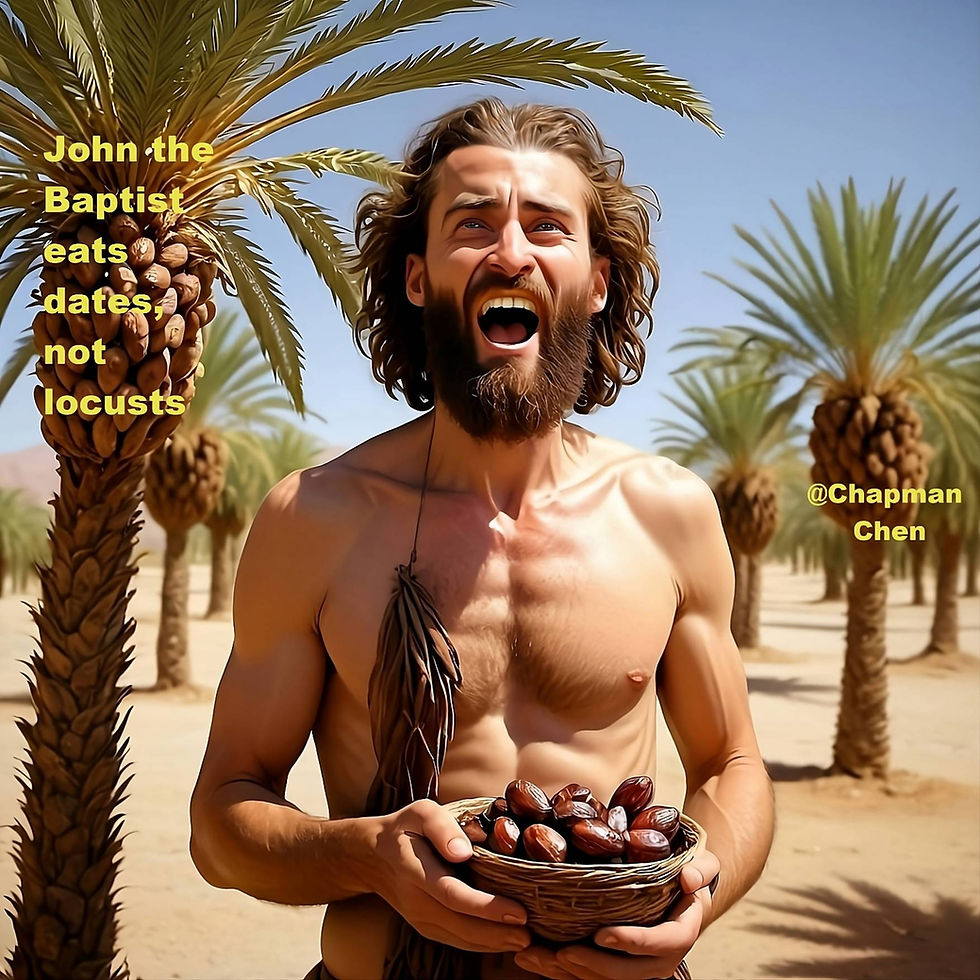
Mark 1:6 states that John the Baptist ate ἀκρίδας (akridas, traditionally translated as “locusts”) and μέλι ἄγριον (meli agrion, “wild honey”); similarly, Matt. 3:4 affirms that his food was ἀκρίδες and μέλι ἄγριον. But John the Baptist, as "a man sent from [the All-Loving] God" (John 1:6-8 NIV) to baptize Jesus Christ, must be compassionate and vegan. So ἀκρίδας may be a typographical error or a deliberate corruption—“by the lying pen of the scribes”—of ἄκριος (akrios), which means “peak,” “upper part,” or, by extension, “tip of a plant.” The plant in question could well be the date palm (mkali), since the Greek ἀκρίδας is rendered as mkali or danakiskudi (date palm) in Old Georgian translations (cf. Barnaveli 2018).
An alternative solution is that ἀκρίδες (akrides, “locusts”) in Matthew 3:4 was originally ἐγκρίδες (egkrides)—the seeds of the carob tree (cf. Ehrman 2013). To this day, carob is still known as “St. John’s bread,” based on the belief that the seeds and pulp were the "locusts" and "honey" eaten by John the Baptist. Per Oxford Reference, “Carob” refers to “the seeds and pod of the tree Ceratonia siliqua, also known as locust bean and St. John’s bread. It contains a sweet pulp which is rich in sugar and gums.” (Oxford Reference 2011 https://www.oxfordreference.com/display/10.1093/oi/authority.20110803095550857#:~:text=Seeds%20and%20pod%20of%20the,the%20preparation%20of%20carob%20gum.). Carob gum is still traded internationally as locust bean gum (Rehm 1991, p. 373).
Likewise, the phrase μέλι ἄγριον (meli agrion, “wild honey”) may have originally referred to melagria, a plant commonly eaten by Judean desert dwellers (Binns 2024).
Full Text Link: https://www.hkbnews.net/post/john-the-vegan-baptist-ate-neither-real-locusts-nor-bee-honey-by-dr-chapman-chen https://www.hkbnews.net/post/john-the-vegan-baptist-ate-neither-real-locusts-nor-bee-honey-by-dr-chapman-chen
7.1. John the Baptist Wears Animal Skin?

Introduction: The Synoptic Gospels describe John the Baptist as wearing “a garment from camel’s hair (ἔνδυμα ἀπῒ τριχῳν καμήλου)” and “a girdle of a skin (ζώνην δερματίνην)” (Matt. 3:4; Mark 1:6). But Jesus describes him as “neither eating bread nor drinking wine” (Luke 7:33, KJV). The Gospel of the Ebionites portrays John the Baptist as consuming manna-like cakes cooked in olive oil (Panarion 30.13.4-5) rather than locusts as depicted in Mark 1:6. An old Slavic version of Josephus’s Antiquities records John as saying that he lived on “cane and roots and tree-food” (Mead 1924, p. 104; cf. Tabor 2015). Given John’s known veganism and asceticism, it is unlikely that he wore animal skins. And the hairy garment and the leather belt can be reinterpreted as follows:
7.1.1. Linguistic Flexibility
The Greek phrases describing John’s clothing could refer to a garment textured like camel hair and a girdle resembling leather rather than actual animal products. Ancient cultures often described fabrics by their appearance rather than their material origin. Likewise, the character pei4 (皮) in the Hong Kong Cantonese phrase pei4baau1 (皮包), literally 'skin bag,' can refer to either synthetic leather, or genuine leather, or any material resembling leather.
7.1.2. Plant-Based Alternatives
In John the Baptist’s time, not all materials resembling fur or leather were of animal origin. There were plant-based substitutes for hairy garments and leather belts, including:
Flax or hemp fabric (coarse and rough, resembling camel hair);
Jute or sisal fibers (used for sackcloth, similar in texture to a camel-hair robe);
Palm or date fibers (woven into rough garments);
Barkcloth (made from the inner bark of trees, e.g., fig, mulberry, and breadfruit, and, when treated with oils or wax, closely resembling tanned leather in texture and function)
Palm fiber or woven reeds (used for belts and ropes);
Linen or hemp stiffened with natural resins or oils (easily mistaken for leather).
7.1.3. Symbolic Interpretation
John the Baptist’s “hairy garment” and “leathern girdle” may not have been intended as a literal description of the fabric’s composition but rather as an indicator of his asceticism and austerity in the style of the prophet Elijah wearing “a hairy garment with a leather belt around his waist” (2 Kings 1:8).
7.1.4. Conclusion
John the Baptist, as a righteous figure (Luke 3:10-11, Luke 3:2, Matt. 3:1, Mark 1:4,), adhered to a vigorous form of austerity, making it highly unlikely that he would wear the skins of innocent creatures, as Kendall Jenner, Jennifer Lopez, and Cate Blanchett do. Given his staunchly vegan diet, the linguistic flexibility of biblical descriptions, and the availability of plant-based textile alternatives, it is reasonable to conclude that John’s clothing was not made of actual animal skins but rather from plant-derived alternatives.
Full Text: https://www.vegantheology.net/post/john-the-baptist-wears-no-animal-skins-by-dr-chapman-chen
8. The Parable of the Prodigal Son Does Not Condone Killing Animals for Food

In the Parable of the Prodigal Son (or the Lost Son) (Luke 15:1-31), Jesus talks about the father ordering his servants to slaughter a fat calf in order to hold a feast and celebrate the son’s return (Luke 15:23). Many flesh-greedy people, including Christian priests and preachers, frequently seize upon this verse to justify the killing of innocent creatures of God for food. However, there is good reason to believe that Jesus never intended to approve of flesh-eating by telling this parable.
Firstly, the command, “Bring the fattened calf and kill it. Let’s have a feast and celebrate. For this son of mine was…lost and is found” (Luke 15:23-24 NIV), is only a line uttered by the father as a character in the parable, not by Jesus nor by God. The father in the parable is just a father very caring about his son, but not necessarily a compassionate vegan caring about animals. In other words, he may be a symbol of God in a certain way but he is NOT the omni-benevolent God per se! And he certainly should not be confused with the storyteller Jesus Christ.
Secondly, consuming the “fattened calf” is simply a kind of metaphor standing for joyfulness and festivity that supposedly, Jesus’ audience was able to comprehend. This was a parable and no calf was in actuality murdered (cf. Christian Vegetarian Association 2013)!. When Jesus' parables referred to slaves, or animal food, he was employing supplementary phraseology which his addressees could relate to (cf. The Fellowship of Life n.d.). Analogously, just because modern people employ idioms like “kill two birds with one stone” doesn’t necessarily mean that they condone such a cruel act (cf. Christian Vegetarian Association 2013)!
In conclusion, the moral lesson of this parable is purely this:- if we confess our mistakes, repent, and return to God’s way, we will be forgiven by Him. The carnivorous feast is merely a figure of speech to describe how warmly God will welcome repentant sinners returning to His bosom, and it should never be taken literally. https://www.hkbnews.net/post/the-parable-of-the-prodigal-son-does-not-condone-killing-animals-for-food-by-dr-chapman-chen
9. Abraham’s Sacrifice of his Son/Ram, Pauline Eucharist, and Meatism are the Same Cult
As summarized below, in Chapters 22-23 of her book, What the Bible Really Says, Pastor Janet Regina Hyland (1998/1988) points out that when Abraham 's attempt at sacrificing his own son Isaac was stopped by an angel from God at the last minute, legitimized human sacrifice came to an official end. Unfortunately, that marked "the beginning of a cult of animal sacrifice that eventually became the central act of worship among the Hebrews", which even the strongest denunciation by Israel’s greatest prophets like Amos, Isaiah, Hosea and Micah could not halt.
"Although Isaiah and the other Latter Prophets demanded an end to the slaughter, they had not taken any direct action against the sacrificial cult. But Jesus did." And it was his planned public assault on the sacrificial system that cost Him His life. The Temple was turned by the chief priests and scribes into a gigantic slaughterhouse, "awash in the blood of its victims." When Jesus disrupted the economic flow therein, they plotted to have Him killed.
After Jesus' death, His disciples carried on His Vegan Church. But then Paul who had never met Jesus came along and maintained that the message he preached came directly from Christ in visions and was THE true message. Refusing to learn anything from Jesus' vegan disciples, he inveighed against them from time to time. As a committed Pharisee, he was a staunch supporter of the sacrifices that were at the heart of Temple worship. He insisted that “without the shedding of blood there is no remission [of sins]” (Hebrews 9:22 NIV). Contrastively, Jesus declared that "I desire compassion rather than sacrifice" (Matthew 9:13 NASB). Moreover, "in his parable of the Prodigal Son, Christ made it very clear that a loving God did not demand atonement from those who had sinned."
While Jesus rejected the concept of a tetchy God, whose wrath cannot be appeased by anything but the blood of a sacrificial victim, Paul "claimed that Jesus died in place of the sinner and that his shed blood met all the demands for retribution demanded by a God who was outraged by sin", thereby ironically transforming Jesus into a sacrificial lamb, the very thing He was protesting (cf. Thompson 2024). So, even though animal sacrifice per se ceased with the crucifixion of Jesus, the sacrificial religion of Atonement as concocted by Paul has become the foundation of mainstream Christian churches for two thousand years!
Meanwhile, in my view, thanks to the predominance of the flesh-greedy Pauline camp in Christianity, animal sacrifice has, after all, persisted in the form of carnivorous offerings to the belly-idol of humankind. https://www.hkbnews.net/post/from-abraham-to-jesus-to-paul-the-evolution-of-a-sacrificial-cult-by-pastor-j-r-hyland-introd
10. Paul Encourages People to Eat Animals Without Guilt
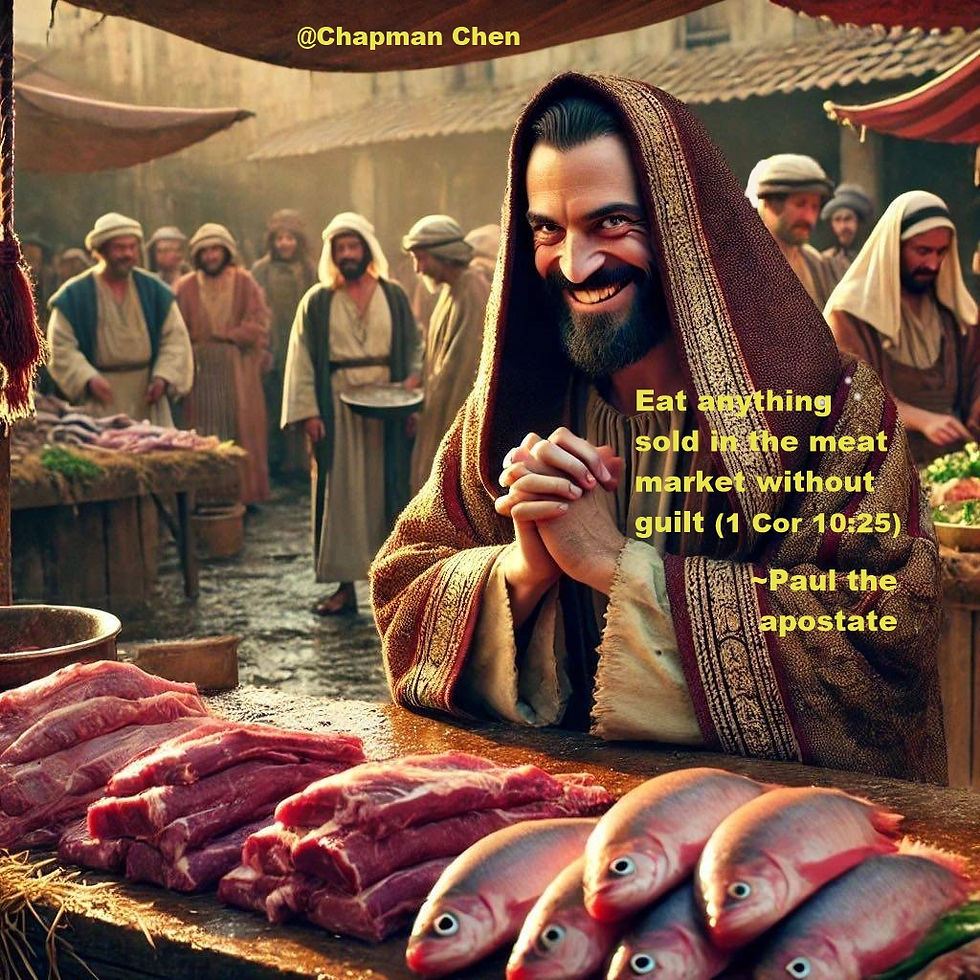
Paul says, "Eat anything sold in the meat market without raising questions of conscience" (1 Corinthians 10:25 NIV). He is adamant that those who are strong in faith may eat anything; whose those who are weak eat only herbs (Romans 14:2), "For meat destroy not the work of God. All things indeed are pure" (Romans 14:20 KJV). Meat here includes but is not limited to animal flesh sacrificed to idols, that is to say, Paul renounces not only the Kosher law but also Christian veganism itself (Akers 2020:149). The reason why Paul should do so is because he's an anti-vegan apostate sent by the Roman Empire to corrupt Jesus' vegan church from the inside out.
10.1. Paul’s Family Background
As disclosed by Paul himself, he was born a Roman citizen (Acts 22:27-28); he was a kinsman of the Herodian family (Romans 16:11); he was closely connected with King Agrippa I and II's Aristobarus-clan (Romans 16:10); and his real name was Saul (Acts 7:58, 8:1-3). According to the Herodian family tree diagram prepared by Eisenman (2019:309), Saulus was Herod the Great's great-nephew and King Agripps II's first cousin twice removed.
Based on Paul's personal details and Saulus' genealogy, and considering Paul's debasement of the veganism of the Jerusalem Council, his attack on Moses' Law (cf. Tabor 2012:210-226), as well as his close association with the Roman authorities, e.g., Governors Felix and Festus, and King Agrippa II (Acts 23:23-35; 24; 25:13-27; 26), Robert Eisenman (2019) identifies Paul as the Herodian Saulus in Josephus' (2009) The War of the Jews, who plundered the poor (the Ebionites) in Jerusalem, and directly reported to Nero; as "the Enemy" in The Clementine Recognitions (Pseudo-Clement 2014) who nearly beat James the Just to death; and as the liar in The Habakkuk Commentary who hijacked Jesus' Vegan Church. If this is true, then Thijs Voskuilen (2005) has a point in contending that Paul "really was an agent-provocateur working for the Roman administration in Palestine..." His mission was to corrupt Jesus' Vegan Church from the inside out. https://www.hkbnews.net/post/the-family-background-of-paul-the-anti-vegan-roman-by-dr-chapman-chen
10.2. Jesus’ Prophesies about Paul

Paul appears to meet Jesus' prophesy about false prophets. “Be careful,” Jesus said to them. “Be on your guard against the yeast of the Pharisees and Sadducees” (Matthew 16:6 NIV) . In Matthew 7:15 KJV, Jesus warns, "Beware of false prophets, which come to you in sheep's clothing, but inwardly they are ravening wolves"! Here, Jesus is alluding to Genesis 49:27, "Benjamin is a ravenous wolf; in the morning he devours the prey, in the evening he divided the plunder" (Genesis 49:27 NIV). Matthew 7:21-22 seems to indicate that the false prophets are Christian, rather than Jewish.
Now, Paul was a self-admitted Benjamite (Romans 11:1). [In fact, the first king of Israel, also named Saul, was a Benjamite who badly persecuted David (I Samuel 18-19)]. Paul, as confessed by himself, had atrociously persecuted vegan Jewish Christians, thus "devouring the prey." Subsequently, he "divided the plunder" and split Christianity:- he was responsible for preaching to the Gentiles whereas the 12 apostles of Jesus were responsible for preaching to the Jews only (Gal. 2:6-9). Moreover, Paul admitted that after his conversion, he remained a Pharisee (Acts 23:6). In the entire New Testament, the only person that embodies the three identities of a Benjaminite, a wolf in Christian sheep's clothing, and a Pharisee is none other than Paul. https://www.hkbnews.net/post/the-vegan-christ-s-four-prophesies-about-paul-by-dr-chapman-chen-hkbnews
10.3. Paul Throws James the Just from the Pinnacle of the Temple

As James the Just was the undisputed leader of Jesus' Vegan Church, Saul/Paul the anti-vegan apostate, in order to hijack Christianity, had to get rid of him first and foremost. So, around 50 AD, according to Clementine Recognitions (1.69-72), while James the Just was debating in the Holy Temple in Jerusalem with the priest about Jesus' Messianic identity, Saul/Paul, as a Roman secret police officer (cf. Eisenman 2019:219-220), assaulted James with a faggot, cast him down from the top of the Temple, and almost killed him. Saul/Paul then headed towards Damascus, with a view to getting Peter, whom he misbelieved had gone. It's precisely on the way to Damascus that Saul/Paul's self-proclaimed conversion by Christ allegedly took place.
In the years to follow, Saul/Paul, posing as "the Apostle", continuously undermined the Jerusalem Council as administered by James and his deputies Peter and John, until 62 AD, when Paul finally succeeded in aiding and abetting the High Priest Ananus to stone James to death. https://www.hkbnews.net/post/paul-the-anti-vegan-throws-james-the-just-off-the-pinnacle-of-the-temple-by-dr-chapman-chen
10.4. Pauls’ Dubious Conversion on his Way to Damascus

The "conversion" of Saul/Paul by Christ on the way to Damascus is a turning point in the history of Christianity. In Acts, Saul/Paul the anti-vegan Roman citizen gave three accounts of it (Acts 9:3-7; Acts 22:6-10; Acts 22:17-21), which are strikingly contradictory regarding, e.g., whether Christ directly instructed him to convert the Gentiles, who fell to the ground, who heard the voice, who saw the light, etc. Such kind of self-conflicting evidence would have been dismissed by a court of law. Further, after the alleged conversion, instead of beating him up and putting him in jail, Paul's secret-police-colleagues—who had set out with him to persecute Jewish Christians—actually left him in the care of a devout Jew (cf. Voskuilen 2005). As Paul was a self-admitted chameleon (1 Corinthians 9:19–22; Romans 3:7) who pathetically repeats that he's not a liar (Romans 9:1; 2 Corinthians 11:31; 1 Timothy 2:7), his conversion was probably a fabrication to serve the purpose of domesticating and corrupting Jesus' Vegan Church from the inside on behalf of the Roman Empire. https://www.hkbnews.net/post/did-paul-the-anti-vegan-make-up-his-conversion-by-dr-chapman-chen
10.5. Paul’s Attack on the Law and the Jerusalem Council’s Vegan Decree

The grievances between Paul and the Jerusalem Council are primarily over veganism rather than circumcision (cf. Akers 2020:149-157). Around A.D. 49, Paul went to meet the Jerusalem Council, ostensibly over the circumcision issue, but there Paul's Greek companion Tius was not compelled to be circumcised (Galatians 2:3). And the apostolic decree issued by James the Just in the meeting merely required Gentile converts to abstain from BLOOD, strangled animals, FOOD sacrificed to idols, and fornication (Acts 15:20). Note that blood is life; life is blood (Andrew Linzey 1993). And “things strangled” plausibly stands for animals subjected to a violent death (Metcalfe, 1840, Ch. 27). Since the Jerusalem Council was still the centre of Christianity in AD 50, and Paul’s group was merely a peripheral organisation, Paul paid lip service to the decree. On the one hand, he diplomatically stated that if eating meat would cause others to stumble, he would rather not eat it (1 Corinthians 8:13); on the other hand, he advised people to eat anything sold in the meat market without guilt (1 Cor. 10:25).

Following the end of the AD 50 Jerusalem Conference (Acts 15), Paul returned to his congregation in Antioch (Acts 15:30-35). Soon after, Peter came to visit and joined them for dinner (Galatians 2:11-12). When Peter withdrew from a table of flesh-eating Gentiles upon hearing from members of the Jerusalem Council, Paul lashed out at Peter, accusing him of intolerance and hypocrisy (Galatians 2:13-14).
When Paul went to the Jerusalem Council in A.D.57, due to a rumour about his telling the Jews to forsake Moses, he said nothing, and the Council just REPEATED the diet-related requirements as in the A.D. 50 meeting, and told Paul to join a purification ceremony (Acts 21;17-26).
To borrow Tabor's words (2012:216), "up until around A.D. 50, during the first decade of Paul's missionary work in the cities of Asia Minor, when he was working with Barnabas, he was not expressing, at least publicly, the full implications of" his hostile attitude towards Moses' Law and Jesus' vegan church. It is not till roughly A.D. 56, with his epistles to the Galatians, Corinthians, and Romans, that we start to have a glance at "Paul's full views about the implications of 'his' gospel" (Tabor 2012:216).
In those letters, Paul blatantly attacks Moses' Law; and more openly reveals his attitude towards Vegan Christianity. In those letters, Regarding the Torah, Paul declares, "all who rely on the works of the law are under a curse" (Galatians 3:10 NIV); "The sting of death is sin, and the power of sin is the law" (1 Corinthians 15:56).
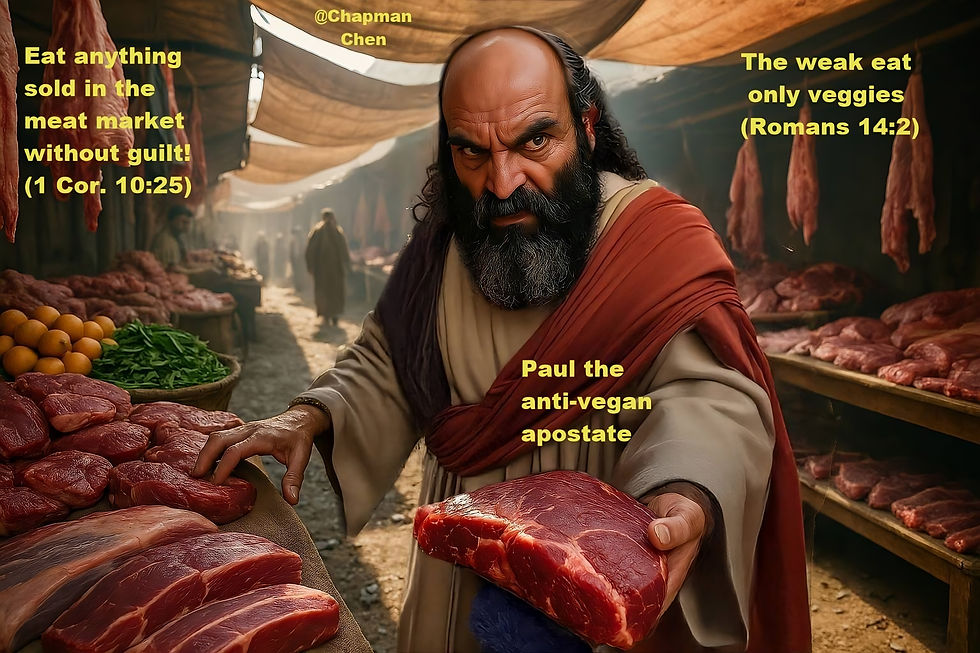
In relation to veganism, Paul asserts that those who are strong in faith may eat anything; whose those who are weak eat only herbs (Romans 14:2), "For meat destroy not the work of God. All things indeed are pure" (Romans 14:20 KJV).
All these grievances came from the fact that Pauline Christianity and Jesus' Jewish Christianity represent two different faiths. Paul wanted to do away with the Mosaic Law, especially veganism, while the Vegan Christ and His disciples aimed at restoring the original compassionate law of God. https://www.hkbnews.net/post/the-grievances-between-paul-and-jesus-vegan-church-by-dr-chapman-chen
10.5.1. Paul Never Fails to Have Roman Protection

When Paul was joining the abovementioned purification ceremony in the Temple, a group of Jews who were angry with him for bringing Gentiles into the Temple without permission, and teaching against Jewish law (Acts 21:28), began to beat up Paul, with the intent to kill him. At this moment, Roman soldiers quickly intervened and arrested Paul, effectively saving him. The Roman commander, Claudius Lysias, ordered Paul to be bound and taken to the barracks (Acts 22:24). When Paul revealed that he was a Roman citizen (Acts 22:25-26), the centurion informed the commander Lysias, who released Paul from his bonds the next day and brought him before the Sanhedrin (the Jewish council) to clarify the accusations against him (Acts 22:30).
Before the Sanhedrin in Acts 23, Paul declared himself to a Pharisee who believed in the resurrection of the dead. This caused a dispute between the Sadducees (who denied the resurrection) and the Pharisees (who affirmed it), leading to chaos. The Roman commander, fearing for Paul's safety, had him taken back to the barracks.
Later, more than forty Jews took a Nazarite-style oath, “saying that they would neither eat nor drink till they had killed Paul” (Acts 23:12 KJV). However, Paul's nephew (unidentified in Acts) overheard the plot and informed the Roman Chief Captain of the Temple Guard in the Fortress, as a result of which, Paul was transferred, under the protection of a significant military contingent consisting of two hundred soldiers, seventy horsemen, and two hundred spearmen, to Caesarea to stand trial before Governor Felix (Acts 23:12-35).
[According to Prof. Robert Eisenman’s (2019/2012) research, Paul’s nephew is likely Julius Archelaus, whom Josephus compliments in his dedication to his book Antiquities as an avid reader of his works. The mother of this young man may be Cypros IV, who was the wife of Helcias the Temple Treasurer and the sister of Saulus/Saul/Paul and Costobarus. Julius Archelaus was briefly married to the Herodian Princess Mariamme III, who was the third sister of King Agrippa II. She later divorced him, likely in favor of Demetrius, the wealthy Alabarch of Alexandria (Eisenman, 2019, pp. 183, 192).]
10.6. Paul Has a Hand in James’ Death

In AD 57-59, Paul was kept on guard in Herod's Palace in Caesarea. But he was able to receive visitors and to preach. He was even once granted temporary leave by the Roman Governor to travel to Macedonia, whence he wrote the 2 Corinthians. In Caesarea, Paul regularly conferred with those in power, including King Agrippa II, Bernice, Felix and Festus. He unabashedly flattered them, probably sharing secret intelligence with them and telling them that his opponent James the Just was the Zaddik of the opposition alliance (Eisenman 2012:202), eventually leading to the stoning to death of James.
In AD 59, Paul actually requested to be transferred to Rome so that he might appeal to Emperor Nero, despite the fact that Agrippa II and Festus thought that he had not committed any serious crime and could be released any minute! So maybe, Paul wanted to reported personally to Nero about the dissenting Jews?

According to Acts of the Apostles, Paul stayed in Rome from AD 60 till AD 62, where again he was allowed to receive visitors and to preach, being escorted by only one guard. By AD 62, Paul had probably returned to Palestine to carry out his mission as a secret agent. There's good reason to believe he was in reality the Saulus who reappeared in Jerusalem in the same year with his (Saulus') brother Costobarus, according to Robert Eisenman (2012:190-192). For both Paul and Saulus were relatives of the Herods (Romans 16:11 ESV), and Paul's original name before his self-claimed conversion by Christ was none but Saul!

In AD 62, Jesus' natural brother, James the Just, was sentenced to death by stoning by the High Priest Ananus. Around AD 64, in the aftermath of Jame's stoning, Saulus/Paul and Costobarus plundered the poor (Eisenman 2012:175, 190). The poor could refer to the Ebionites, the most important group of early vegan Jewish Christians, for Ebionite in Greek means poor. https://www.vegantheology.net/post/a-chronicle-of-paul-the-anti-vegan-apostate-by-dr-chapman-chen
10.7. Paul’s Role in the Fall of Jerusalem
In AD 66, as a consequence of James' martyrdom, a revolution against Roman colonialism broke out. Saulus/Paul, falsely representing the "peace party" in Jerusalem, went out of the city, and pleaded with Agrippa II to invite the Roman army outside to enter Jerusalem and suppress the revolution. The Roman troops, in response to the invitation, matched into the city. They managed to occupy parts of Jerusalem but did not have complete control over the entire city (Eisenman 2012:192) .

In AD 68, James' Jewish followers avenged his murder by slaying the High Priest Ananus and leaving his corpse naked and unburied. The Roman Commander had failed to capture Jerusalem and retreated to the coast. Saulus/Paul fled with Costobarus to Cestius' camp and then to Nero in Corinth, where Saulsu/Paul gave a briefing to His Majesty on the situation in Palestine, and successfully recommended Vespasian to be the person-in-charge of the repression of the uprising in Palestine (Eisenman 2012:192-193)
Early Church texts put Paul's death some time after the outbreak of the War against Rome, around the years 68-69 CE. Here we do begin to approach convergence with Josephus' 'Saulus' who disappears at approximately the same time from Josephus' reporting, though not before he provided Nero with a final briefing in Corinth on events in Palestine (Eisenman 2012: 193).

Vespasian initiated the Roman campaign in the Jewish War. In AD 70, Vespasian's son Titus, completed the siege of Jerusalem, captured and totally destroyed the city. Most of the vegan Jewish Christians were killed.
We do not know what happened next. Some have suggested Paul may have gone on to Spain as he had said he wanted to. However, there is no reliable information on his ultimate fate. We do not know when or how he died. The conclusion seems to be justified, however, that there is no reason to assume the Romans stopped protecting him, as they had been doing for years by that time. He had practically become a personal investment to them. Moreover, they would have to have been utterly blind not to see that Saul of Tarsus was furthering their goals by his actions, speeches and writings under the name of ‘Paul’. Therefore, it seems unlikely that they would suddenly decide to martyr him, as Christian mythology has insisted. After all, why would the Romans kill one of their own citizens, a (former) member of the secret police in Jerusalem, who: (a) said that God’s salvation had come upon them; (b) that ‘the Jews’ were bad; and (c) that everyone had to pay their taxes to the Roman authorities, be a good citizen and refrain from resisting persecutions? https://www.vegantheology.net/post/a-chronicle-of-paul-the-anti-vegan-apostate-by-dr-chapman-chen


Comments