


Jude and James: Two Pro-Vegan, Anti-Paul Books (Part I). By Dr Chapman Chen
- Chapman Chen

- Jul 3
- 3 min read
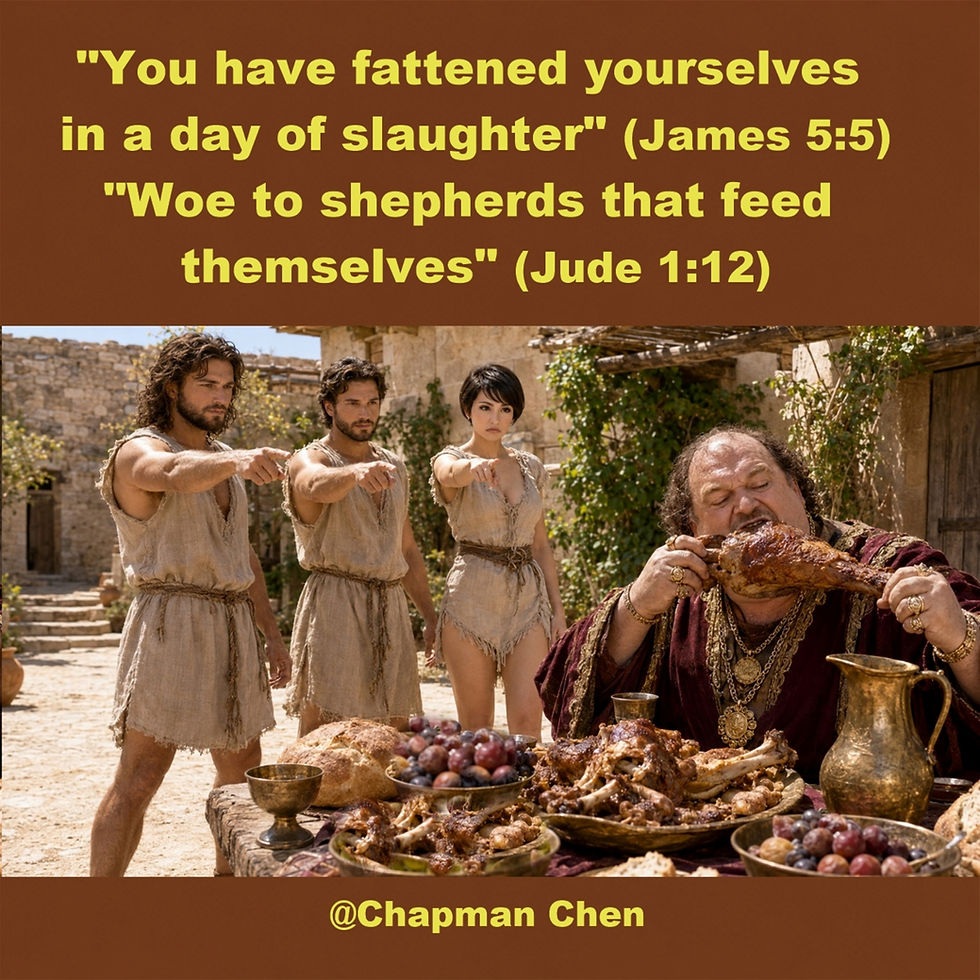
Summary: Both Jude and James are Jesus’ natural brothers. Jude implies that Paul has sneakily crept into vegan Christianity (Jude 1:4-5), that the Pauline camp rail at veganism which they fail to understand, that they corrupt themselves by “understanding” animals physically (phusikós) (Jude 1:10) (cf. Holmes-Gore 1946, pp. 18-19), that they are evil-doers like Cain (Jude 1:10-12), and that they are “hidden rocks” in Jesus’ vegan Eucharist, as well as shepherds that feed themselves the sheep (Jude 1:13-14). Similarly, James accuses fake Christians of “fattening (trephó)” themselves by slaughtering the innocent (James 5:5). He denounces them for violating “Thou shalt not kill”, while self-importantly following the Commandment against adultery (James 2:10-11). Whereas Paul preaches that we are justified by faith instead of works, James emphasizes that faith sans works is void (James 2: 14-end).
1. “Certain Men Crept in Privily”
Jude points out that “there are certain men crept in privily, even they who were of old written of beforehand unto this condemnation, ungodly men, turning the grace of our God into lasciviousness, and denying our only Master and Lord, Jesus Christ” (Jude 1:4-5 KJV). The phrase “crept in” is particularly applicable to Paul, who entered the fellowship in spite of strong opposition from the true disciples (Acts 6:23-26). Paul/Saul, a Herodian (Romans 16:11), could also be a secret agent sent by the Roman Empire to corrupt Jesus’ vegan church from the inside out (Akers 2000; Eisenman 2012; Voskuilen 2005)! Jude actually compares these ungodly men to “Sodom and Gormorrha… going after strange flesh” (Jude 1:7 ASV), which may mean animal flesh.
2. They Understand Animals Physically
“These men”, Jude goes on, “revile anything they do not happen to be acquainted with and do not understand; and whatever they do understand physically (phusikós)… like irrational beasts–by these they corrupt themselves and are destroyed” (Jude 1:10 AMPC). Among the things which Paul railed at because he did not understand their true significance we must reckon veganism. For example, he calls vegans weaklings (Rom 14:2) and deviants from the faith (1 Tim 4:1), and he encourages people to eat whatever is sold in the meat market without questions of conscience (1 Cor 10:25). Per Strong's Exhaustive Concordance, phusikós is an adverb, which primarily means physically and, by implication, instinctively or naturally. The reference may be to the perverse use which the Pauline camp made of their bodies and of animal products (cf. James 5:5: “ye have fattened your hearts in a day of slaughter”) (cf. Holmes-Gore 1946, p.19). 3. They Went in the Way of Cain and Balaam
“Woe unto them! for they went in the way of Cain, and ran riotously in the error of Balaam for hire,” Jude further condemns these men (Jude 1:10-12 ASV).
The reference to destruction may be the ground for introducing Cain – the “physical” or fallen in contrast to the spiritual person – who was also the earliest murderer.
For Balaam is an example of evil transgression (cf. Rev 2:14).
4. Shepherds that Without Fear Feed Themselves
Jude is adamant that these evil-doers “are hidden rocks in your (Jesus’) love-feasts when they feast with you, shepherds that without fear feed themselves” (Jude 1:13-14 ASV). The Pauline camp could fittingly be called “hidden rocks” or “spots” in Christ’s Eucharist because they turned Jesus into the very thing He was protesting – a sacrificial lamb! And His vegan last supper into a cannibalistic ritual (cf. Tabor 2012:14-15) (n.1).
5. Jesus the Good Shepherd vs Paul the Exploitative Shepherd
Paul’s apparent angst to protect himself against the accusation of “living on” the Gospel (I Cor 10) may imply that his adversaries deemed him a shepherd who fed himself at the expense of his sheep. While Jesus is “a good shepherd [who] lays down his life for his sheep (John 10:11), Pauline meat-greedy shepherds want the sheep to lay down their lives for them. Just like Jesus, Peter says, “Be shepherds of God’s flock that is under your care, watching over them… eager to serve; not lording it over those entrusted to you, but being examples to the flock” (I Peter 5:2-3). Yet, Paul for sure lorded it over his flock (cf. Holmes-Gore 1946).
Notes
1. The idea of eating Jesus’ flesh and drinking His blood in communion comes straight from Paul the anti-vegan apostate (cf. Tabor 2012:14-15). Relevant narrations about the Eucharist as a cannibalistic cult in the four Gospels (Matt. 26:26–28; Mark 14:22–24; Luke 22:19–20) are almost word-for-word copies of Paul’s discourse (1 Corinthians 10:16-17, 11:23-26). Paul’s take is clear: no bloodshed, no remission (Heb. 9:22). He literally turned Jesus, who declared “I desire compassion, not sacrifice” (Matt. 9:13; 12:7), into the very thing He (Jesus) was protesting—a sacrificial lamb (cf. Thompson 2024)! Whereas Paul inherits the anti-vegan sacrificial cult of the high priests and scribes, Jesus succeeds the five vegan prophets in the OT.


Comments