

Queen Esther's Life-saving Vegan Banquets. By Dr Chapman Chen

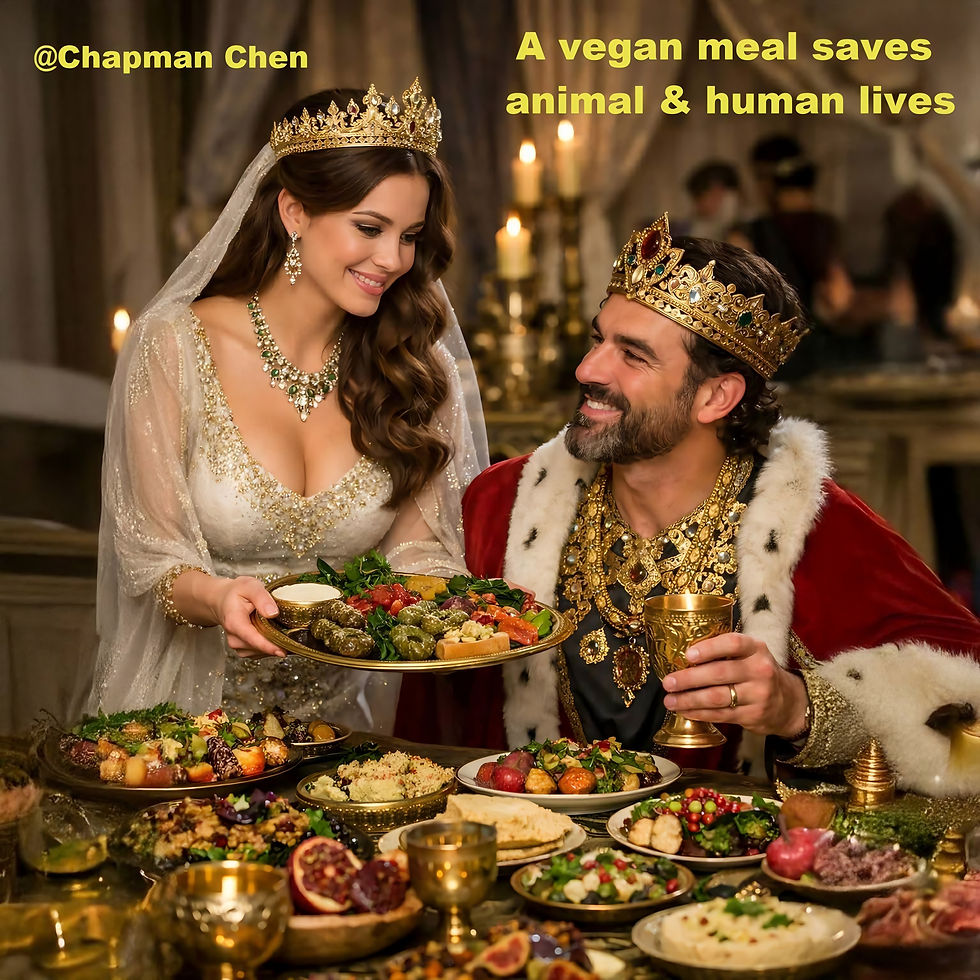
The Feb. 28 strike that killed Iran’s Supreme Leader Ali Khamenei on occurred on the eve of Purim — the festival commemorating the downfall of Haman, thanks to Queen Esther’s intervention through her beauty, her wisdom, and her superb vegan culinary skills. Whether this timing is coincidence or carries deeper symbolic meaning is something people of faith may reflect upon.
1. Ali Khamenei and Haman
Numerous human-rights organisations, such as the Human Rights Activists News Agency (HRANA), accuse the Iranian regime under Ali Khamenei of severe repression, including the use of lethal force against thousands of protesters, among them hundreds of minors. Some commentators — e.g., Houman David Hemmati, MD, PhD — therefore draw parallels with Haman in the Book of Esther (Megillat Esther), a powerful official in ancient Persia who plotted the mass destruction of the Jewish people.
2. Purim as a Joyful Jewish Festival
Purim is celebrated on the 14th day of the Hebrew month of Adar. Because the Jewish calendar is lunar-solar, this date moves each year on the Gregorian (Western) calendar. This year Purim will take place on the evening of March 2 through March 3. Tis one of the most exuberant & playful Jewish festivals— full of feasting, costumes, gifts, charity, & public reading of Megillah and/or the Book of Esther in the OT.
The name Purim (Hebrew: פּוּרִים, Pūrīm, “lots”) comes from the “lots” Haman the villain cast to determine the date of the planned annihilation: “They cast Pur (that is, the lot)… to determine the day and the month.”— Esther 3:7
Without Esther, there would be no Purim.
3. The Plot of the Book of Esther
The story takes place during the reign of King Ahasuerus in the First Persian Empire. The former queen, the first wife of King Ahasuerus, is banished from the court for disobeying the king's orders. A beauty pageant is held to find a new queen (2:1–4).
Among these women is a Jewish orphan named Esther, who was raised by her cousin or uncle, Mordecai (2:5–7). She finds favour in the King's eyes and is crowned his new queen, but does not reveal her Jewish heritage (2:8–20).
3.1. A Vegan Secretly Jewish Queen
Acc. to traditional Jewish sources, such as Megillah 13a, Esther — a secretly Jewish queen in a non-kosher palace — likely adopted a vegan diet to maintain ritual purity, consuming only seeds, legumes, fruits, and nuts, much like the prophet Daniel in Babylon. Yet beyond practical necessity, Esther’s diet may also reveal a deeper ethical vision.
Shortly afterwards, Mordecai discovers a plot by two courtiers to assassinate Ahasuerus. The conspirators are apprehended and hanged, and Mordecai's service to the King is officially recorded (2:21–23).
Meanwhile, King Ahasuerus appoints Haman as his viceroy (3:1). Mordecai falls into Haman's disfavour, as he refuses to kneel down to him (3:2–5).
Haman, in revenge, plots to kill not just Mordecai but all the Jews in the empire (3:6). He persuades Ahasuerus to authorize this plan on the ground that the Jews observe different customs and wouldn’t obey the Persian authorities. Haman draws lot ("purim") to choose the date on which to do this – the thirteenth of the month of Adar (3:7–12). A royal decree is issued throughout the kingdom to slay all Jews on that date (3:13–15). When Mordecai discovers the plan, he implores Esther to intercede with the King (4:1–5).

3.2. Two Life-Saving Vegan Banquets
Rather than confronting the king immediately, Esther invites him and Haman to two private banquets, presumably vegan, carefully staged to turn the tide of history.
At the first banquet (Esther 5:1–8), Esther secures the king’s favour but postpones her true request, inviting them again the following day. This deliberate delay heightens royal curiosity and lulls Haman into a false sense of security.
At the second banquet (Esther 7:1–10), Esther courageously reveals her Jewish identity and exposes Haman’s scheme. The king, outraged, orders Haman to be executed on the very gallows he had prepared for Esther’s cousin Mordecai. A new decree is issued allowing the Jews to defend themselves — and they are saved.
4. A Quiet Act of Ethical Resistance
In the heart of the Persian Empire, Queen Esther orchestrated not only a political masterstroke but also, quite possibly, a compassionate culinary stand
Through wisdom, patience, and moral courage, Esther’s vegan banquets became the setting for one of the most dramatic reversals in biblical history. They represent not merely a strategy for maintaining kosher observance in exile but also a quiet act of ethical resistance.
5. A Moral Clarity to Confront Injustice & Violence
As Kohenet Yael Tischler (2020) insightfully suggests, Esther’s diet may be understood as an expression of empathy. Living as a concealed minority in a foreign court, Esther knew what it meant to be “othered”. In choosing compassion even at the royal table, she embodied the moral clarity that later enabled her to confront injustice at the highest level of power.
Today, the Jewish festival of Purim commemorates Esther’s heroism and the deliverance of her people from oppression and massacre. Yet her story may also invite reflection on the quiet strength underlying her actions — the hidden disciplines, incl. dietary choices, that sustain courage and fidelity under pressure. Esther’s example suggests that acts of compassion, even those unseen by the world, can prepare the ground for transformative justice.
A vegan meal saves both animal and human lives.


Comments