


The Messianic Vegan Banquet vs Two Non-Vegan Ones (Part II). By Dr Chapman Chen
- Chapman Chen

- Mar 14
- 4 min read
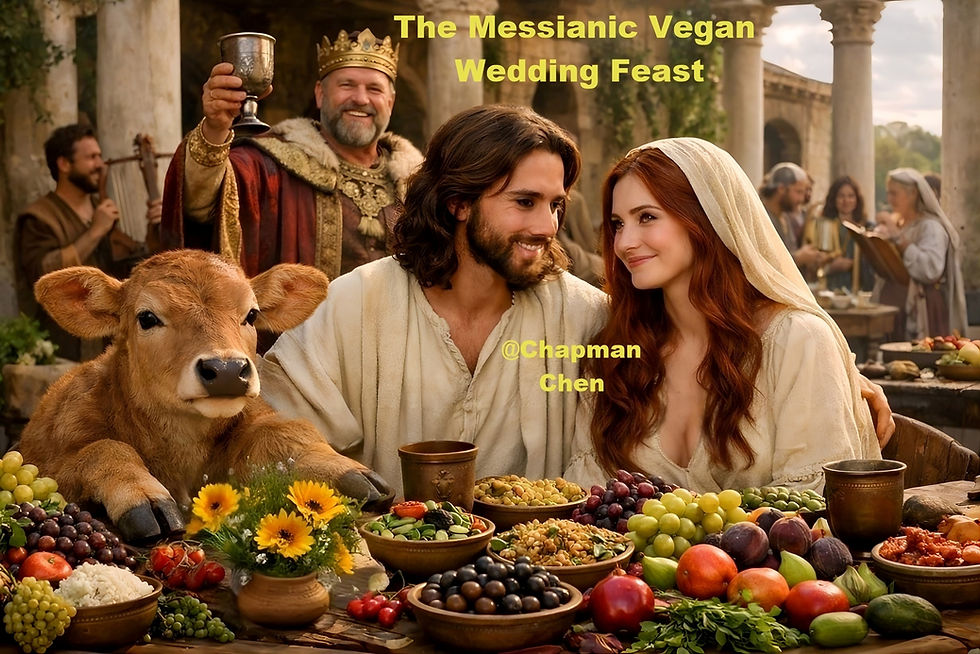
In contrast to the aforementioned non-vegan feasts included in the Parable of the Royal Banquet and the Parable of the Prodigal Son as told by Jesus, the wedding feast of the Messiah Himself is vegan. Various biblical passages describe a vegan wedding banquet in the New Heaven and New Earth, where the Messiah and His bride—representing the Church or God's enlightened ones—are united (Rev 19:7–9; Hos 2:19–20; Exod 20:13; John 3:16; Song of Solomon 2:16; Isa 25:6).. And if we were to name an iconic feminine figure as the bride, it would undoubtedly be Mary Magdalene (note 1). To qualify as VIPs for the grand wedding feast of Jesus Christ and Mary Magdalene, we must prepare our wedding garments (Matt 22:11) in the form of vegan love and compassion for both our human and non-human neighbours (Mark 12:31). We will link these passages together as follows.
1. The Marriage of the Lamb
First of all, the bride is prepared and gracefully dressed to receive her husband:- "I saw the Holy City, the new Jerusalem, coming down out of heaven from God, prepared as a bride beautifully dressed for her husband" (Revelation 21:2 NIV). The bride is equipped with righteous deeds and ready for the marriage with the Messiah, which is an animal-friendly occasion on account of its being called the marriage of the Lamb:- "Let us rejoice and exult and give him the glory, for the marriage of the Lamb has come, and his Bride has made herself ready; it was granted her to clothe herself with fine linen, bright and pure”—for the fine linen is the righteous deeds of the saints." (Rev 19:7-9ESV).
2. Betrothed in Love and Compassion
Then the bridegroom and the bride exchange vows with each other. "I will betroth you to me forever; I will betroth you in righteousness and justice, in love and compassion. I will betroth you in faithfulness, and you will acknowledge the Lord." (Hos 2:19-20 NIV). The bridegroom declares that He will betroth the bride in righteousness, justice, love, compassion and faithfulness. And, of course, without veganism, there could be no true compassion. For God loves the world (John 3:16), including ALL His creation (Psalm 145:9); and “Thou shalt not kill!” (Exod 20:13).
3. He “Grazes Among the Lilies!
And the lady affirms that she and her man are exclusively committed to each other. The fact that her beloved man or the Messiah “grazes among the lilies” (Song of Solomon 2:16 ESV) indicates that He is staunchly vegan.
4. Food Drenched in Olive Oil
After the exchange of vows, Almighty God arranges a vegan banquet of lavish animal-friendly delicacies soaked in olive oil plus the finest grape juice for all nations. "On this mountain the Lord Almighty will prepare a feast of rich food for all peoples, a banquet of aged grape juice—rich food drenched in olive oil and the finest of grape juice" (Isa 25:6, my trans.). The “rich food drenched in olive oil” (Hebrew: shemen machah) of the messianic banquet in Isaiah 25:6, however, is mistranslated by NASB, KJV and NIV as “choice pieces with marrow”, “fat things full of marrow” and “the best meats”, respectively. Actually, “shemen” means oil, esp. olive oil, NOT animal fat; “machah” means "to rub, smooth, erase, or grease" and, by implication, oiliness or richness rather than animal bone marrow.
5. How to Qualify as Guests
Guests invited to this Messianic, animal-friendly, vegan wedding feast are blessed in a very privileged way. "Blessed are those who are invited to the wedding supper of the Lamb!" (Rev 19:9, NIV).
To qualify as VIPs for the grand wedding feast of Jesus Christ and Mary Magdalene, we must prepare one’s wedding garments (Matt 22:11) in the form of vegan love and compassion for both our human and non-human neighbours (Mark 12:31).
6. Conclusion
To put it in a nutshell, the Parable of the Royal Banquet teaches that, provided we answer God’s call, we will be included in the Kingdom of God. The Parable of the Prodigal Son teaches that sinners will be generously forgiven and welcomed by the Father, provided they confess, repent, and turn over a new leaf. Neither of these stories, which involve non-vegan banquets, is meant to serve as a dietary textbook. The non-vegan banquets in these parables are also counterbalanced by the Messiah’s own vegan wedding banquet, to which all compassionate and righteous people will be admitted as VIPs.
Notes
1. The Gospel of Mary reveals that Jesus entrusted Mary Magdalene with secret teachings (Ch. 5.7-11, 8.10-24). This caused resentment among other disciples, particularly Andrew and Peter (Ch. 9.2-4), but Levi (Matthew) defended her (Ch. 6-9); and confirmed that Jesus knew her well and loved her more than all the other disciples, and that she was meant to lead the disciples after His departure (Ch. 6-10). Scholars recognize her as a key leader in early Christianity (King 2003; Schaberg 2002). Full text: https://www.vegantheology.net/post/jesus-and-mary-magdalene-as-vegan-companions-by-dr-chapman-chen


Comments